The temperature within the Earth’s crust increases about 1.0 C° for each 30 m of depth. The thermal conductivity of the crust is 0.80 J/s C°. Determine the heat transferred from the interior to the surface for the entire Earth in 1.0 h.
Giancoli Douglas 5th edition
Ch. 19 - Heat and the First Law of Thermodynamics
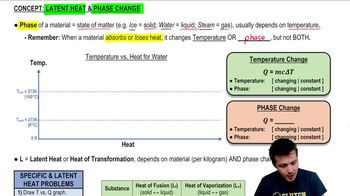
Problem 77What will be the final result when equal masses of ice at 0°C and steam at 100°C are mixed together?
Verified step by step guidance
Verified video answer for a similar problem:
Key Concepts
Phase Change
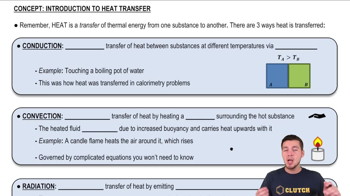
Heat Transfer
Latent Heat
(a) Estimate the total power radiated into space by the Sun, assuming it to be a perfect emitter at T = 5500 K. The Sun’s radius is 7.0 x 10⁸ m.
(b) From this, determine the power per unit area arriving at the Earth, 1.5 x 10¹¹ m away (Fig. 19–37).
A microwave oven is used to heat 250 g of water. On its maximum setting, the oven can raise the temperature of the liquid water from 20°C to 100°C in 1 min 45 s ( = 105 s).
(a) At what rate does the oven put energy into the liquid water?
(b) If the power input from the oven to the water remains constant, determine how many grams of water will boil away if the oven is operated for 2 min (rather than just 1 min 45 s).
A ceramic teapot (e = 0.70) and a shiny metal one (e = 0.10) each hold 0.55 L of tea at 85°C. (a) Estimate the rate of heat loss from each, and (b) estimate the temperature drop after 30 min for each. Consider only radiation, and assume the surroundings are at 20°C.
A copper rod and an aluminum rod of the same length and cross-sectional area are attached end to end (Fig. 19–35). The copper end is placed in a furnace maintained at a constant temperature of 205°C. The aluminum end is placed in an ice bath held at a constant temperature of 0.0°C. Calculate the temperature at the point where the two rods are joined.