
Ch. 19 - Heat and the First Law of Thermodynamics
Giancoli Douglas - Physics for Scientists and Engineers 5th edition
Giancoli Douglas5th editionPhysics for Scientists and EngineersISBN: 9780137488179Not the one you use?Change textbook
Chapter 19, Problem 86a

The temperature within the Earth’s crust increases about 1.0 C° for each 30 m of depth. The thermal conductivity of the crust is 0.80 J/s C°. Determine the heat transferred from the interior to the surface for the entire Earth in 1.0 h.

Verified step by step guidance
1
Understand the problem: The heat transfer through the Earth's crust is governed by the concept of thermal conduction. The formula for heat transfer via conduction is given by: Q = (k)(A)(ΔT)(t)/d, where Q is the heat transferred, k is the thermal conductivity, A is the surface area, ΔT is the temperature difference, t is the time, and d is the thickness of the crust.
Identify the given values: The thermal conductivity of the crust is k = 0.80 J/s°C. The temperature gradient is 1.0°C per 30 m, which can be used to calculate ΔT/d. The time is t = 1.0 hour (convert to seconds). The surface area of the Earth is approximately A = 4πr^2, where r = 6.37 × 10^6 m.
Calculate the temperature gradient: The temperature gradient is given as ΔT/d = 1.0°C per 30 m. Convert this to ΔT/d = 1.0/30°C/m.
Substitute the known values into the heat transfer formula: Replace k, A, ΔT/d, and t in the formula Q = (k)(A)(ΔT)(t)/d. Ensure that the time t is converted to seconds (1 hour = 3600 seconds) and the Earth's surface area is calculated using A = 4πr^2.
Simplify the expression to find Q: Perform the necessary algebraic simplifications to express Q in terms of the substituted values. This will give the total heat transferred from the Earth's interior to its surface in 1.0 hour.

Verified video answer for a similar problem:

This video solution was recommended by our tutors as helpful for the problem above.
Video duration:
7m
Was this helpful?

Key Concepts

Here are the essential concepts you must grasp in order to answer the question correctly.

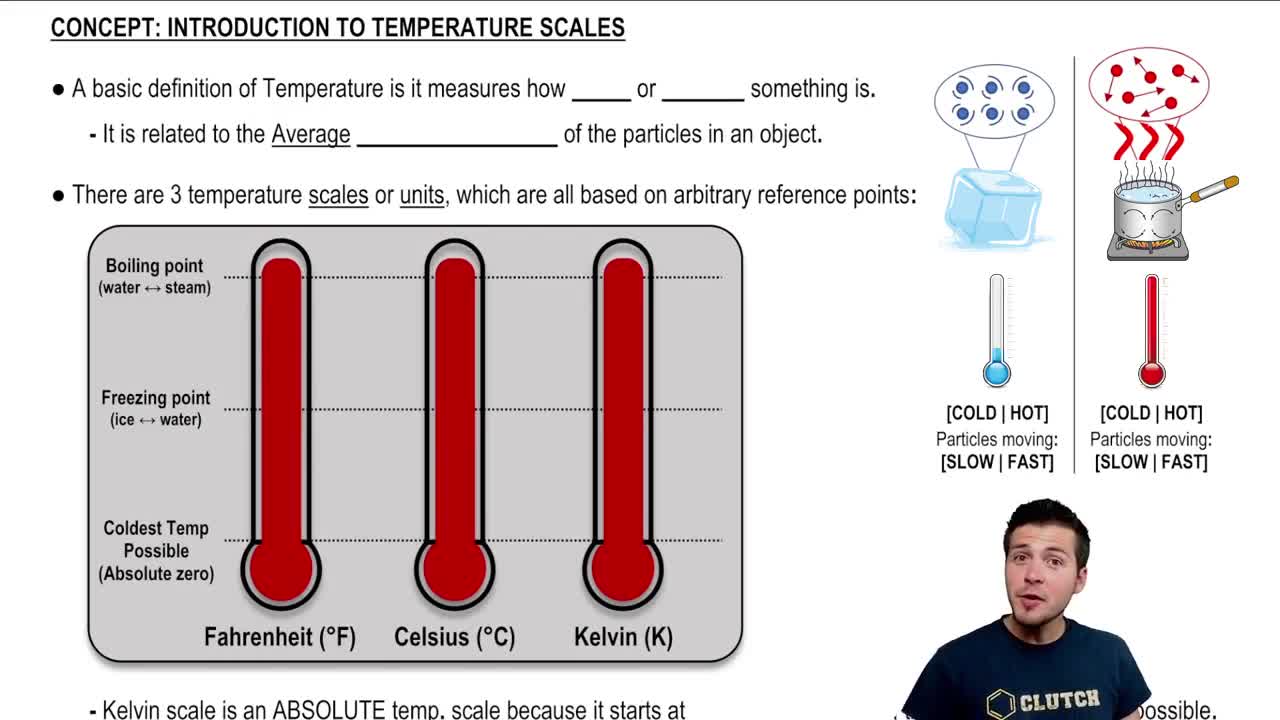
Temperature Gradient

The temperature gradient refers to the rate at which temperature increases with depth in the Earth's crust. In this case, it is given as 1.0 °C for every 30 meters. Understanding this gradient is crucial for calculating how temperature changes with depth and how it influences heat transfer processes.
Recommended video:
Guided course
04:54
Introduction To Temperature Scales

Thermal Conductivity

Thermal conductivity is a material property that indicates how well heat is conducted through a substance. For the Earth's crust, a thermal conductivity of 0.80 J/s°C means that for every degree of temperature difference, 0.80 joules of heat will flow through a meter of the crust per second. This concept is essential for determining the rate of heat transfer from the Earth's interior to its surface.
Recommended video:
Guided course
05:21
Volume Thermal Expansion

Heat Transfer Calculation

Heat transfer calculation involves determining the amount of heat energy that moves from one location to another over a specific time period. In this scenario, it requires using the temperature gradient and thermal conductivity to find the total heat transferred from the Earth's interior to the surface over one hour. This calculation is fundamental in understanding geothermal energy and the thermal dynamics of the Earth.
Recommended video:
Guided course
05:14
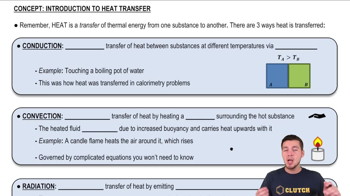
Overview of Heat Transfer