Ch. 12 - Static Equilibrium; Elasticity and Fracture
Giancoli Douglas - Physics for Scientists and Engineers 5th edition
Giancoli Douglas5th editionPhysics for Scientists and EngineersISBN: 9780137488179Not the one you use?Change textbook
Chapter 12, Problem 6

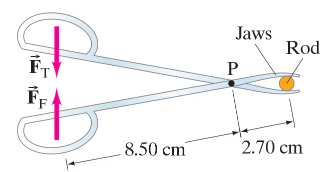
Figure 12–53 shows a pair of forceps used to hold a thin plastic rod firmly. If the thumb and finger each squeeze with a force FT = FF = 11.0 N, what force do the forceps jaws exert on the plastic rod?
Illustration of forceps gripping a plastic rod, showing forces applied and measurements labeled.

Verified step by step guidance
1
Analyze the problem: The forceps act as a type of lever, where the thumb and finger apply forces at one end, and the jaws exert a force on the plastic rod at the other end. The forces applied by the thumb and finger are equal and opposite, creating a torque about the pivot point of the forceps.
Identify the pivot point: The pivot point is the location where the forceps rotate. The forces applied by the thumb and finger create torques about this pivot point, and the force exerted by the jaws on the plastic rod is the result of these torques.
Set up the torque equation: The torque due to the thumb and finger forces must balance the torque exerted by the jaws on the plastic rod. Use the equation for torque: τ = F × d, where F is the force and d is the perpendicular distance from the pivot point to the line of action of the force.
Express the relationship: Let d_T and d_J represent the distances from the pivot point to the thumb/finger forces and the jaws, respectively. The torque balance equation is: F_T × d_T = F_J × d_J, where F_J is the force exerted by the jaws on the plastic rod.
Solve for F_J: Rearrange the equation to find the force exerted by the jaws: F_J = (F_T × d_T) / d_J. Substitute the given values for F_T (11.0 N) and the distances (d_T and d_J) to calculate the force exerted by the jaws.

Verified video answer for a similar problem:

This video solution was recommended by our tutors as helpful for the problem above.
Video duration:
5m
Was this helpful?

Key Concepts

Here are the essential concepts you must grasp in order to answer the question correctly.

Newton's Third Law of Motion

Newton's Third Law states that for every action, there is an equal and opposite reaction. This principle is crucial in understanding how forces interact in the system of the forceps and the plastic rod. When the thumb and finger apply forces to the rod, the rod exerts an equal and opposite force back on the forceps, which helps determine the resultant force exerted on the rod.
Recommended video:
Guided course
08:01
Newton's Third Law & Action-Reaction Pairs

Force Transmission in Mechanical Systems

In mechanical systems like forceps, forces applied at one point can be transmitted and amplified at another point. The configuration of the forceps allows the forces applied by the thumb and finger to be concentrated at the jaws, resulting in a greater effective force on the plastic rod. Understanding this concept is essential for calculating the total force exerted on the rod.
Recommended video:
Guided course
09:12
Solving Force Problems in Connected Systems of Objects

Equilibrium of Forces

The concept of equilibrium involves the balance of forces acting on an object. In this scenario, the forces exerted by the thumb and finger must be analyzed to determine the net force acting on the plastic rod. If the system is in equilibrium, the total force exerted by the forceps on the rod will equal the sum of the forces applied by the thumb and finger, allowing for a straightforward calculation of the resultant force.
Recommended video: