Ch. 12 - Static Equilibrium; Elasticity and Fracture
Giancoli Douglas - Physics for Scientists and Engineers 5th edition
Giancoli Douglas5th editionPhysics for Scientists and EngineersISBN: 9780137488179Not the one you use?Change textbook
Chapter 12, Problem 2

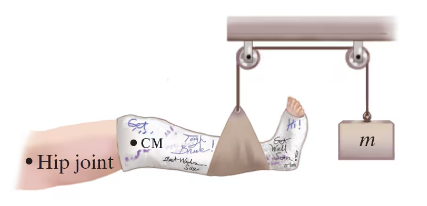
Calculate the mass m needed in order to suspend the leg shown in Fig. 12–50. Assume the leg (with cast) has a mass of 15.0 kg, and its cg is 35.0 cm from the hip joint; the cord holding the sling is 78.0 cm from the hip joint.
Illustration of a leg in a cast suspended by a pulley system, showing hip joint, center of mass, and mass m for equilibrium calculation.

Verified step by step guidance
1
Identify the forces acting on the system: The leg (with cast) has a weight due to gravity, which acts downward through its center of gravity (cg). The tension in the cord holding the sling provides an upward force to balance the torque caused by the leg's weight.
Define the pivot point: The hip joint is the pivot point for this problem. The torques about this point must balance for the system to be in equilibrium.
Write the torque equilibrium condition: The sum of the torques about the hip joint must equal zero. The torque due to the leg's weight is \( \tau_{\text{leg}} = m_{\text{leg}} g d_{\text{leg}} \), where \( m_{\text{leg}} \) is the mass of the leg, \( g \) is the acceleration due to gravity, and \( d_{\text{leg}} \) is the distance from the hip joint to the leg's center of gravity. The torque due to the tension in the cord is \( \tau_{\text{cord}} = T d_{\text{cord}} \), where \( T \) is the tension in the cord and \( d_{\text{cord}} \) is the distance from the hip joint to the cord.

Relate the tension in the cord to the mass \( m \): The tension in the cord is caused by the weight of the mass \( m \) hanging from it. Thus, \( T = m g \). Substitute this into the torque equation.
Solve for the mass \( m \): Using the torque equilibrium condition \( \tau_{\text{leg}} = \tau_{\text{cord}} \), substitute the expressions for the torques and solve for \( m \): \( m = \frac{m_{\text{leg}} d_{\text{leg}}}{d_{\text{cord}}} \). Plug in the given values for \( m_{\text{leg}} = 15.0 \ \text{kg} \), \( d_{\text{leg}} = 0.35 \ \text{m} \), and \( d_{\text{cord}} = 0.78 \ \text{m} \) to find the required mass.

Verified video answer for a similar problem:

This video solution was recommended by our tutors as helpful for the problem above.
Video duration:
5m
Was this helpful?

Key Concepts

Here are the essential concepts you must grasp in order to answer the question correctly.

Torque

Torque is a measure of the rotational force applied to an object around a pivot point. It is calculated as the product of the force and the distance from the pivot point to the line of action of the force. In this problem, the leg's weight creates a torque about the hip joint, which must be balanced by the torque produced by the mass m hanging from the cord.
Recommended video:
Guided course
08:55
Net Torque & Sign of Torque

Center of Gravity (cg)

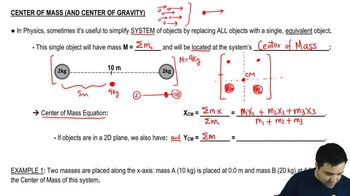
The center of gravity is the point at which the total weight of an object is considered to act. For the leg in this scenario, the cg is located 35.0 cm from the hip joint. Understanding the position of the center of gravity is crucial for calculating the torques acting on the system and ensuring equilibrium.
Recommended video:
Guided course
14:02
Intro to Center of Mass

Equilibrium

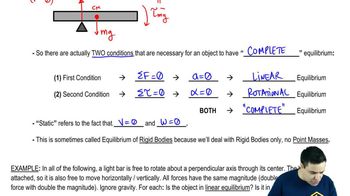
Equilibrium occurs when the sum of all forces and torques acting on a system is zero, resulting in no net motion. In this case, the system is in static equilibrium, meaning the torque due to the weight of the leg must equal the torque due to the mass m. This principle allows us to set up an equation to solve for the unknown mass.
Recommended video:
Guided course
10:13
Torque & Equilibrium