Ch. 12 - Static Equilibrium; Elasticity and Fracture
Giancoli Douglas - Physics for Scientists and Engineers 5th edition
Giancoli Douglas5th editionPhysics for Scientists and EngineersISBN: 9780137488179Not the one you use?Change textbook
Chapter 12, Problem 14

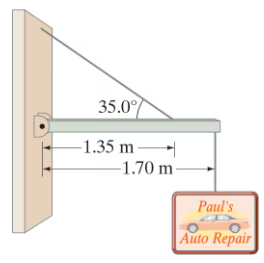
A shop sign weighing 215 N hangs from the end of a uniform 135-N beam as shown in Fig. 12–59. Find the tension in the supporting wire (at 35.0°), and the horizontal and vertical forces exerted by the hinge on the beam at the wall.
Diagram of a beam supported at an angle with a shop sign, showing dimensions and forces for equilibrium analysis.

Verified step by step guidance
1
Identify the forces acting on the system: The forces include the weight of the sign (215 N), the weight of the beam (135 N), the tension in the supporting wire (T), and the horizontal and vertical components of the hinge force (F_h and F_v).
Set up the torque equilibrium equation about the hinge: Since the system is in static equilibrium, the sum of torques about the hinge must be zero. Use the equation \( \sum \tau = 0 \), where \( \tau = r \cdot F \cdot \sin(\theta) \). Consider the torques due to the weight of the sign, the weight of the beam, and the tension in the wire.
Set up the force equilibrium equations: The system is also in translational equilibrium, so the sum of forces in both the horizontal and vertical directions must be zero. Use \( \sum F_x = 0 \) for horizontal forces and \( \sum F_y = 0 \) for vertical forces.
Solve for the tension in the wire (T): Use the torque equilibrium equation to isolate \( T \). Substitute the distances from the hinge to the center of mass of the beam and the sign, as well as the angle of the wire (35.0°).
Solve for the horizontal and vertical components of the hinge force: Use the force equilibrium equations to find \( F_h \) and \( F_v \) by substituting the value of \( T \) obtained from the previous step and balancing the forces in both directions.

Verified video answer for a similar problem:

This video solution was recommended by our tutors as helpful for the problem above.
Video duration:
12m
Was this helpful?

Key Concepts

Here are the essential concepts you must grasp in order to answer the question correctly.

Equilibrium of Forces

In physics, an object is in equilibrium when the net force acting on it is zero. This means that all the forces acting on the object must balance out. For the shop sign and beam system, this involves analyzing both the vertical and horizontal forces to ensure that they sum to zero, allowing us to determine the tension in the supporting wire and the forces at the hinge.
Recommended video:

Torque

Torque is a measure of the rotational force applied to an object, calculated as the product of the force and the distance from the pivot point (the hinge, in this case). In this scenario, we need to consider the torques created by the weight of the sign and the beam about the hinge to find the tension in the wire. The sum of the torques must also equal zero for the system to be in rotational equilibrium.
Recommended video:
Guided course
08:55
Net Torque & Sign of Torque

Trigonometric Functions

Trigonometric functions, such as sine and cosine, relate the angles of a triangle to the ratios of its sides. In this problem, the angle of the supporting wire (35.0°) will be used to resolve the tension into its vertical and horizontal components. Understanding how to apply these functions is crucial for calculating the forces acting on the beam and ensuring equilibrium.
Recommended video:
Guided course
08:30
Intro to Wave Functions
Related Practice
Textbook Question

A 2300-kg trailer is attached to a stationary truck at point B, Fig. 12–64. Determine the normal force exerted by the road on the rear tires at A, and the vertical force exerted on the trailer by the support B.

1
views

Textbook Question

Figure 12–53 shows a pair of forceps used to hold a thin plastic rod firmly. If the thumb and finger each squeeze with a force FT = FF = 11.0 N, what force do the forceps jaws exert on the plastic rod?

1
views
Textbook Question

A 172-cm-tall person lies on a light (massless) board which is supported by two scales, one under the top of her head and one beneath the bottom of her feet (Fig. 12–65). The two scales read, respectively, 35.1 and 31.6 kg. What distance is the center of gravity of this person from the top of her head?

<IMAGE>

2
views
Textbook Question

Calculate the mass m needed in order to suspend the leg shown in Fig. 12–50. Assume the leg (with cast) has a mass of 15.0 kg, and its cg is 35.0 cm from the hip joint; the cord holding the sling is 78.0 cm from the hip joint.

1
views
Textbook Question

Three children are trying to balance on a seesaw, which includes a fulcrum rock acting as a pivot at the center, and a very light board 3.2 m long (Fig. 12–60). Two playmates are already on either end. Boy A has a mass of 45 kg, and boy B a mass of 35 kg. Where should girl C, whose mass is 25 kg, place herself so as to balance the seesaw?

3
views
Textbook Question

(II) The force required to pull the cork out of the top of a wine bottle is in the range of 200 to 400 N. What range of forces F is required to open a wine bottle with the bottle opener shown in Fig. 12–58?

<IMAGE>

1
views