Ch. 12 - Static Equilibrium; Elasticity and Fracture
Giancoli Douglas - Physics for Scientists and Engineers 5th edition
Giancoli Douglas5th editionPhysics for Scientists and EngineersISBN: 9780137488179Not the one you use?Change textbook
Chapter 12, Problem 15

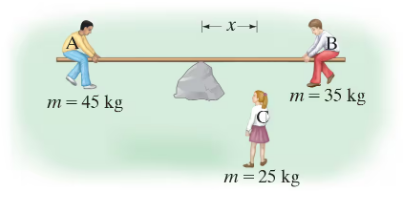
Three children are trying to balance on a seesaw, which includes a fulcrum rock acting as a pivot at the center, and a very light board 3.2 m long (Fig. 12–60). Two playmates are already on either end. Boy A has a mass of 45 kg, and boy B a mass of 35 kg. Where should girl C, whose mass is 25 kg, place herself so as to balance the seesaw?
Three children on a seesaw with a rock fulcrum; boy A (45 kg) and boy B (35 kg) balance while girl C (25 kg) finds her position.

Verified step by step guidance
1
Understand the problem: The seesaw is in rotational equilibrium, meaning the sum of the torques about the fulcrum must be zero. Torque is calculated as the product of force (weight) and the perpendicular distance from the pivot point. The goal is to find the position of girl C such that the torques on both sides of the fulcrum balance.
Define the system: The seesaw is 3.2 m long, so the fulcrum is at the center, dividing the board into two halves of 1.6 m each. Boy A is at one end (1.6 m from the fulcrum), and boy B is at the other end (also 1.6 m from the fulcrum). Girl C's position is unknown, and we will denote her distance from the fulcrum as \( x \).
Write the torque equation: The clockwise torque caused by boy A must equal the counterclockwise torque caused by boy B and girl C. Using \( \tau = F \cdot d \), where \( F \) is the weight (mass \( \cdot \) gravity) and \( d \) is the distance from the fulcrum, the equation becomes: \( (45 \cdot 9.8 \cdot 1.6) = (35 \cdot 9.8 \cdot 1.6) + (25 \cdot 9.8 \cdot x) \).
Simplify the equation: Cancel out the common factor of \( 9.8 \) (gravitational acceleration) from all terms, leaving: \( 45 \cdot 1.6 = 35 \cdot 1.6 + 25 \cdot x \). Expand and simplify further to isolate \( x \): \( 72 = 56 + 25x \).
Solve for \( x \): Subtract \( 56 \) from both sides to get \( 16 = 25x \). Then divide both sides by \( 25 \) to find \( x \): \( x = \frac{16}{25} \). This gives the distance girl C should place herself from the fulcrum to balance the seesaw.

Verified video answer for a similar problem:

This video solution was recommended by our tutors as helpful for the problem above.
Video duration:
9m
Was this helpful?

Key Concepts

Here are the essential concepts you must grasp in order to answer the question correctly.

Torque

Torque is a measure of the rotational force applied around a pivot point, calculated as the product of the force and the distance from the pivot. In the context of a seesaw, each child's weight creates a torque about the fulcrum, which must be balanced for the seesaw to remain level. The formula for torque is τ = r × F, where τ is torque, r is the distance from the pivot, and F is the force (weight in this case).
Recommended video:
Guided course
08:55
Net Torque & Sign of Torque

Equilibrium

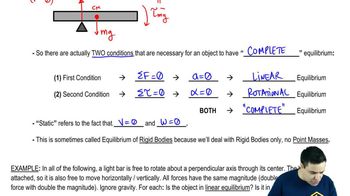
Equilibrium in physics refers to a state where all forces and torques acting on an object are balanced, resulting in no net force or rotation. For the seesaw to be in equilibrium, the sum of the torques produced by the children on either side of the fulcrum must be equal. This principle allows us to determine where girl C should sit to achieve balance.
Recommended video:
Guided course
10:13
Torque & Equilibrium

Center of Mass

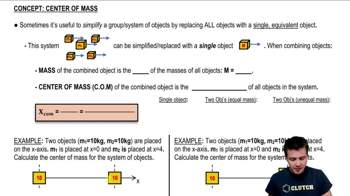
The center of mass is the point at which the mass of an object is evenly distributed in all directions. In a seesaw scenario, the position of each child relative to the fulcrum affects the overall center of mass of the system. Understanding how to locate the center of mass helps in determining the correct position for girl C to balance the seesaw with the other two children.
Recommended video:
Guided course
06:30
Intro to Center of Mass
Related Practice
Textbook Question

A 2300-kg trailer is attached to a stationary truck at point B, Fig. 12–64. Determine the normal force exerted by the road on the rear tires at A, and the vertical force exerted on the trailer by the support B.

1
views
Textbook Question

A shop sign weighing 215 N hangs from the end of a uniform 135-N beam as shown in Fig. 12–59. Find the tension in the supporting wire (at 35.0°), and the horizontal and vertical forces exerted by the hinge on the beam at the wall.

1
views
Textbook Question

A uniform rod AB of length 4.5 m and mass M = 3.8 kg is hinged at A and held in equilibrium by a light cord, as shown in Fig. 12–69. A load W = 22 N hangs from the rod at a distance d so that the tension in the cord is 85 N. Draw a free-body diagram for the rod.

1
views
Textbook Question

Figure 12–53 shows a pair of forceps used to hold a thin plastic rod firmly. If the thumb and finger each squeeze with a force FT = FF = 11.0 N, what force do the forceps jaws exert on the plastic rod?

1
views
Textbook Question

A 172-cm-tall person lies on a light (massless) board which is supported by two scales, one under the top of her head and one beneath the bottom of her feet (Fig. 12–65). The two scales read, respectively, 35.1 and 31.6 kg. What distance is the center of gravity of this person from the top of her head?

<IMAGE>

2
views
Textbook Question

(II) The force required to pull the cork out of the top of a wine bottle is in the range of 200 to 400 N. What range of forces F is required to open a wine bottle with the bottle opener shown in Fig. 12–58?

<IMAGE>

1
views