

A uniform beam of mass M and length ℓ is mounted on a hinge at a wall as shown in Fig. 12–101. It is held in a horizontal position by a wire making an angle θ as shown. A mass m is placed on the beam a distance x from the wall, and this distance can be varied. Determine, as a function of x, the components of the force exerted by the beam on the hinge.
Giancoli Douglas 5th edition
Ch. 12 - Static Equilibrium; Elasticity and Fracture
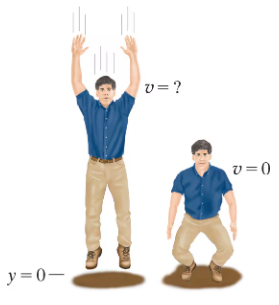
Problem 95eSuppose a 65-kg person jumps from a height of 3.0 m down to the ground. Estimate the stress and determine if the tibia will break in a stiff-legged landing (d = 1.0 cm).

Verified step by step guidance
Verified video answer for a similar problem:
Key Concepts
Potential Energy
Impact Force
Stress and Strain
A steel rod of radius R = 15 cm and length ℓ₀ stands upright on a firm surface. A 78-kg man climbs atop the rod. When a metal is compressed, each atom throughout its bulk moves closer to its neighboring atom by exactly the same fractional amount. If iron atoms in steel are normally 2.0 x 10⁻¹⁰ m apart, by what distance did this interatomic spacing have to change in order to produce the normal force required to support the man? [Note: Neighboring atoms repel each other, and this repulsion accounts for the observed normal force.]
If 25 kg is the maximum mass m that a person can hold in a hand when the arm is positioned with a 105° angle at the elbow as shown in Fig. 12–102, what is the maximum force Fₘₐₓ that the biceps muscle exerts on the forearm? Assume the forearm and hand have a total mass of 2.0 kg with a cg that is 15 cm from the elbow, and that the biceps muscle attaches 5.0 cm from the elbow.