
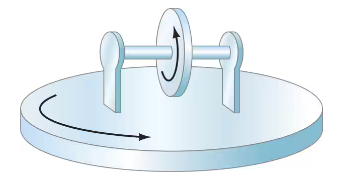
The axle of a wheel is mounted on supports that rest on a rotating turntable as shown in Fig. 10–52. The wheel has angular velocity ω₁ = 48.0 rad/s about its axle, and the turntable has angular velocity ω₂ = 35.0 rad/s about a vertical axis. (Note arrows showing these motions in the figure.) What are the directions of and at the instant shown?
The axle of a wheel is mounted on supports that rest on a rotating turntable as shown in Fig. 10–52. The wheel has angular velocity ω₁ = 48.0 rad/s about its axle, and the turntable has angular velocity ω₂ = 35.0 rad/s about a vertical axis. (Note arrows showing these motions in the figure.) What is the magnitude and direction of the angular acceleration of the wheel at the instant shown? Take the 𝒵 axis vertically upward and the direction of the axle at the moment shown to be the 𝓍 axis pointing to the right.

Verified step by step guidance
Verified video answer for a similar problem:
Key Concepts
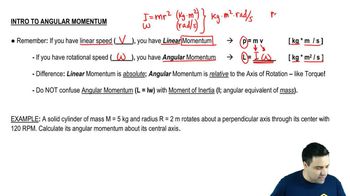
Angular Velocity
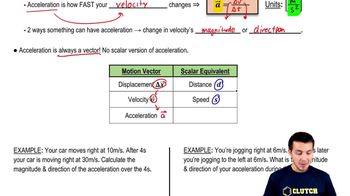
Angular Acceleration
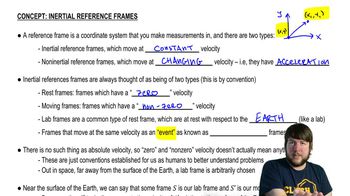
Reference Frames
A turntable of radius R₁ is turned by a circular rubber roller of radius R₂ in contact with it at their outer edges. What is the ratio of their angular velocities, ω₁/ω₂?
The bolts on the cylinder head of an engine require tightening to a torque of 95 m-N. If the six-sided bolt head is 15 mm across (Fig. 10–55), estimate the force applied near each of the six points by a wrench.
The axle of a wheel is mounted on supports that rest on a rotating turntable as shown in Fig. 10–52. The wheel has angular velocity ω₁ = 48.0 rad/s about its axle, and the turntable has angular velocity ω₂ = 35.0 rad/s about a vertical axis. (Note arrows showing these motions in the figure? What is the resultant angular velocity of the wheel, as seen by an outside observer, at the instant shown? Give the magnitude and direction.
The angular acceleration of a wheel, as a function of time, is α = 4.2 t² ― 9.0 t , where α is in rad/s² and t in seconds. If the wheel starts from rest (θ = 0 , ω = 0, at t = 0), determine a formula for the angular position θ, both as a function of time.
Pilots can be tested for the stresses of flying high-speed jets in a whirling “human centrifuge,” which takes 1.0 min to turn through 26 complete revolutions before reaching its final speed. What was its final angular speed in rpm?
