Ch. 10 - Rotational Motion
Giancoli Douglas - Physics for Scientists and Engineers 5th edition
Giancoli Douglas5th editionPhysics for Scientists and EngineersISBN: 9780137488179Not the one you use?Change textbook
Chapter 10, Problem 31b

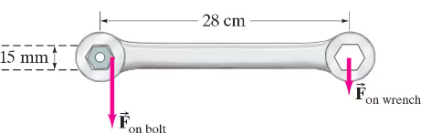
The bolts on the cylinder head of an engine require tightening to a torque of 95 m-N. If the six-sided bolt head is 15 mm across (Fig. 10–55), estimate the force applied near each of the six points by a wrench.
Diagram of a wrench applying force to a bolt, with dimensions labeled: 28 cm length and 15 mm bolt head width.

Verified step by step guidance
1
Understand the relationship between torque, force, and lever arm. Torque (τ) is given by the formula: τ=Frsin(θ), where F is the force applied, r is the lever arm (distance from the axis of rotation to the point of force application), and θ is the angle between the force and the lever arm.
In this problem, the force is applied perpendicular to the lever arm, so sin(θ)=1. This simplifies the torque formula to: τ=Fr.
The lever arm (r) is half the distance across the bolt head, as the force is applied near the edge. Convert the given distance of 15 mm to meters: r=152×103=0.0075m.
Rearrange the torque formula to solve for the force: F=τr. Substitute the given torque (95 N·m) and the calculated lever arm (0.0075 m) into the equation.
Perform the division to find the force applied near each of the six points. This force will be the same at each point since the torque is distributed evenly across the bolt head.

Verified video answer for a similar problem:

This video solution was recommended by our tutors as helpful for the problem above.
Video duration:
9m
Was this helpful?

Key Concepts

Here are the essential concepts you must grasp in order to answer the question correctly.

Torque

Torque is a measure of the rotational force applied to an object, calculated as the product of the force and the distance from the pivot point (lever arm). In this case, the torque required to tighten the bolts is given as 95 m•N, indicating the amount of rotational force needed to achieve the desired tightness.
Recommended video:
Guided course
08:55
Net Torque & Sign of Torque

Lever Arm

The lever arm is the perpendicular distance from the line of action of the force to the pivot point. For the bolts, the lever arm is half the width of the bolt head, which is 7.5 mm (or 0.0075 m). This distance is crucial for calculating the force applied, as it directly influences the torque generated by the wrench.
Recommended video:
Guided course
06:58
Ice skater closes her arms

Force Distribution

When multiple points of force are applied, such as with the six bolts, the total torque must be distributed among them. To find the force at each bolt, the total torque is divided by the number of bolts and the lever arm. This concept is essential for understanding how the torque requirement translates into the force exerted at each bolt head.
Recommended video:
Guided course
04:03
Probability Distribution Graph
Related Practice
Textbook Question

Determine the net torque on the 2.0-m-long uniform beam shown in Fig. 10–56. All forces are shown. Calculate about point P at one end.

1
views

Textbook Question

The angular acceleration of a wheel, as a function of time, is α = 4.2 t² ― 9.0 t , where α is in rad/s² and t in seconds. If the wheel starts from rest (θ = 0 , ω = 0, at t = 0), determine a formula for the angular position θ, both as a function of time.

1
views
Textbook Question

The forearm in Fig. 10–57 accelerates a 3.6-kg ball at 7.0 m/s² by means of the triceps muscle, as shown. Calculate the torque needed.

1
views
Textbook Question

Pilots can be tested for the stresses of flying high-speed jets in a whirling “human centrifuge,” which takes 1.0 min to turn through 26 complete revolutions before reaching its final speed. What was its final angular speed in rpm?

1
views
Textbook Question

A softball player swings a bat, accelerating it from rest to 2.4 rev/s in a time of 0.20 s. Approximate the bat as a 0.90-kg uniform rod of length 0.95 m, and compute the torque the player applies to one end of it.

1
views
Textbook Question

The axle of a wheel is mounted on supports that rest on a rotating turntable as shown in Fig. 10–52. The wheel has angular velocity ω₁ = 48.0 rad/s about its axle, and the turntable has angular velocity ω₂ = 35.0 rad/s about a vertical axis. (Note arrows showing these motions in the figure.) What is the magnitude and direction of the angular acceleration of the wheel at the instant shown? Take the 𝒵 axis vertically upward and the direction of the axle at the moment shown to be the 𝓍 axis pointing to the right.

2
views