
Ch. 10 - Rotational Motion
Giancoli Douglas - Physics for Scientists and Engineers 5th edition
Giancoli Douglas5th editionPhysics for Scientists and EngineersISBN: 9780137488179Not the one you use?Change textbook
Chapter 10, Problem 20b

Pilots can be tested for the stresses of flying high-speed jets in a whirling “human centrifuge,” which takes 1.0 min to turn through 26 complete revolutions before reaching its final speed. What was its final angular speed in rpm?

Verified step by step guidance
1
Determine the total time taken for the centrifuge to complete 26 revolutions. The problem states that this time is 1.0 minute, which can be converted to seconds for consistency in calculations: \( t = 1.0 \text{ min} = 60 \text{ s} \).
Calculate the average angular velocity \( \omega_{\text{avg}} \) during the motion. The formula for average angular velocity is \( \omega_{\text{avg}} = \frac{\Delta \theta}{\Delta t} \), where \( \Delta \theta \) is the total angular displacement in radians and \( \Delta t \) is the time interval. Since there are 26 revolutions, convert this to radians using \( 1 \text{ revolution} = 2\pi \text{ radians} \): \( \Delta \theta = 26 \times 2\pi \).
Substitute \( \Delta \theta \) and \( \Delta t \) into the formula for \( \omega_{\text{avg}} \): \( \omega_{\text{avg}} = \frac{26 \times 2\pi}{60} \). This gives the average angular velocity in radians per second.
Recognize that the centrifuge starts from rest and accelerates uniformly to its final angular speed \( \omega_f \). For uniform angular acceleration, the relationship between the final angular speed, average angular speed, and initial angular speed is \( \omega_{\text{avg}} = \frac{\omega_i + \omega_f}{2} \). Since \( \omega_i = 0 \), simplify to \( \omega_{\text{avg}} = \frac{\omega_f}{2} \).
Solve for the final angular speed \( \omega_f \) in radians per second: \( \omega_f = 2 \cdot \omega_{\text{avg}} \). Finally, convert \( \omega_f \) from radians per second to revolutions per minute (rpm) using the conversion factors \( 1 \text{ revolution} = 2\pi \text{ radians} \) and \( 1 \text{ minute} = 60 \text{ seconds} \): \( \omega_f (\text{rpm}) = \omega_f (\text{rad/s}) \cdot \frac{60}{2\pi} \).

Verified video answer for a similar problem:

This video solution was recommended by our tutors as helpful for the problem above.
Video duration:
4m
Was this helpful?

Key Concepts

Here are the essential concepts you must grasp in order to answer the question correctly.

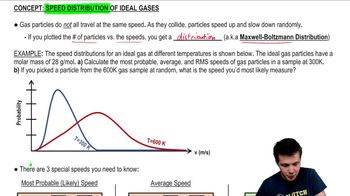
Angular Speed

Angular speed is a measure of how quickly an object rotates around a central point or axis. It is typically expressed in radians per second or revolutions per minute (rpm). In this context, we need to calculate the final angular speed of the centrifuge after it completes its revolutions.
Recommended video:
Guided course
07:59
Speed Distribution & Special Speeds of Ideal Gases

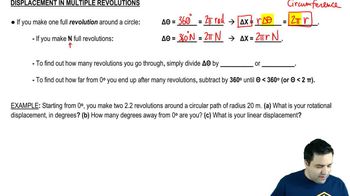
Revolutions and Time

A revolution refers to a complete turn around a circle. To find the angular speed in rpm, we need to relate the number of revolutions to the time taken. In this case, the centrifuge completes 26 revolutions in 1.0 minute, which allows us to calculate the angular speed by dividing the total revolutions by the time in minutes.
Recommended video:
Guided course
05:58
Displacement in Multiple Revolutions

Conversion of Units

Unit conversion is essential in physics to ensure that measurements are in compatible units for calculations. Here, we need to convert the time from minutes to seconds if necessary, but since we are calculating rpm, we can directly use the time in minutes. Understanding how to convert between different units is crucial for accurate results.
Recommended video:
Guided course
07:46
Unit Conversions
Related Practice
Textbook Question

The axle of a wheel is mounted on supports that rest on a rotating turntable as shown in Fig. 10–52. The wheel has angular velocity ω₁ = 48.0 rad/s about its axle, and the turntable has angular velocity ω₂ = 35.0 rad/s about a vertical axis. (Note arrows showing these motions in the figure.) What are the directions of ω1\(\overrightarrow{\omega_1}\) and ω2\(\overrightarrow{\omega_2}\) at the instant shown?

1
views
Textbook Question

The bolts on the cylinder head of an engine require tightening to a torque of 95 m-N. If the six-sided bolt head is 15 mm across (Fig. 10–55), estimate the force applied near each of the six points by a wrench.

1
views
Textbook Question

Determine the net torque on the 2.0-m-long uniform beam shown in Fig. 10–56. All forces are shown. Calculate about point P at one end.

1
views
Textbook Question

The axle of a wheel is mounted on supports that rest on a rotating turntable as shown in Fig. 10–52. The wheel has angular velocity ω₁ = 48.0 rad/s about its axle, and the turntable has angular velocity ω₂ = 35.0 rad/s about a vertical axis. (Note arrows showing these motions in the figure? What is the resultant angular velocity of the wheel, as seen by an outside observer, at the instant shown? Give the magnitude and direction.

2
views
Textbook Question

The angular acceleration of a wheel, as a function of time, is α = 4.2 t² ― 9.0 t , where α is in rad/s² and t in seconds. If the wheel starts from rest (θ = 0 , ω = 0, at t = 0), determine a formula for the angular position θ, both as a function of time.

1
views
Textbook Question

The axle of a wheel is mounted on supports that rest on a rotating turntable as shown in Fig. 10–52. The wheel has angular velocity ω₁ = 48.0 rad/s about its axle, and the turntable has angular velocity ω₂ = 35.0 rad/s about a vertical axis. (Note arrows showing these motions in the figure.) What is the magnitude and direction of the angular acceleration of the wheel at the instant shown? Take the 𝒵 axis vertically upward and the direction of the axle at the moment shown to be the 𝓍 axis pointing to the right.

2
views