Ch. 10 - Rotational Motion
Giancoli Douglas - Physics for Scientists and Engineers 5th edition
Giancoli Douglas5th editionPhysics for Scientists and EngineersISBN: 9780137488179Not the one you use?Change textbook
Chapter 10, Problem 17

A turntable of radius R₁ is turned by a circular rubber roller of radius R₂ in contact with it at their outer edges. What is the ratio of their angular velocities, ω₁/ω₂?

Verified step by step guidance
1
Understand the problem: The turntable and the rubber roller are in contact at their outer edges, meaning they have the same tangential velocity at the point of contact. This is the key to solving the problem.
Express the tangential velocity for each object. The tangential velocity is related to the angular velocity and radius by the formula: \( v = \omega R \), where \( v \) is the tangential velocity, \( \omega \) is the angular velocity, and \( R \) is the radius.
Since the tangential velocities at the point of contact are equal, set the tangential velocities of the turntable and the roller equal to each other: \( \omega_1 R_1 = \omega_2 R_2 \).
Rearrange the equation to solve for the ratio of angular velocities: \( \frac{\omega_1}{\omega_2} = \frac{R_2}{R_1} \).
Conclude that the ratio of their angular velocities is inversely proportional to the ratio of their radii: \( \frac{\omega_1}{\omega_2} = \frac{R_2}{R_1} \). This means the larger the radius of one object, the smaller its angular velocity compared to the other.

Verified video answer for a similar problem:

This video solution was recommended by our tutors as helpful for the problem above.
Video duration:
2m
Was this helpful?

Key Concepts

Here are the essential concepts you must grasp in order to answer the question correctly.

Angular Velocity

Angular velocity is a measure of how quickly an object rotates around a central point or axis, typically expressed in radians per second. It indicates the rate of change of the angular position of an object and is crucial for understanding rotational motion. In this context, the angular velocities of the turntable and the rubber roller are key to determining their relationship.
Recommended video:
Guided course
06:18
Intro to Angular Momentum

Radius and its Role in Rotation

The radius of a rotating object is the distance from the center of rotation to the edge of the object. In rotational dynamics, the radius affects the linear speed of points on the object’s edge and is directly related to angular velocity. For two objects in contact, their radii will influence the ratio of their angular velocities, as the point of contact must move at the same linear speed.
Recommended video:
Guided course
06:18
Calculating Radius of Nitrogen

Relationship Between Linear and Angular Velocity

The relationship between linear velocity (v) and angular velocity (ω) is given by the equation v = rω, where r is the radius. This relationship implies that for two objects in contact, the linear velocities at the point of contact must be equal, leading to the ratio of their angular velocities being inversely proportional to their radii. Thus, understanding this relationship is essential for solving the problem.
Recommended video:
Guided course
11:10
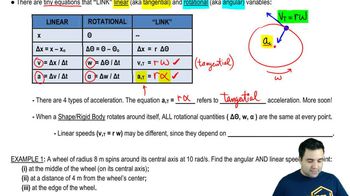
Converting Between Linear & Rotational
Related Practice
Textbook Question

How fast (in rpm) must a centrifuge rotate if a particle 8.0 cm from the axis of rotation is to experience an acceleration of 100,000 g’s?

2
views

Textbook Question

The axle of a wheel is mounted on supports that rest on a rotating turntable as shown in Fig. 10–52. The wheel has angular velocity ω₁ = 48.0 rad/s about its axle, and the turntable has angular velocity ω₂ = 35.0 rad/s about a vertical axis. (Note arrows showing these motions in the figure.) What are the directions of ω1\(\overrightarrow{\omega_1}\) and ω2\(\overrightarrow{\omega_2}\) at the instant shown?

1
views
Textbook Question

(II) A child rolls a ball on a level floor 3.1 m to another child. If the ball makes 12.0 revolutions, what is its diameter?

2
views
Textbook Question

The axle of a wheel is mounted on supports that rest on a rotating turntable as shown in Fig. 10–52. The wheel has angular velocity ω₁ = 48.0 rad/s about its axle, and the turntable has angular velocity ω₂ = 35.0 rad/s about a vertical axis. (Note arrows showing these motions in the figure? What is the resultant angular velocity of the wheel, as seen by an outside observer, at the instant shown? Give the magnitude and direction.

2
views
Textbook Question

A child rolls a ball on a level floor 3.1 m to another child. If the ball makes 12.0 revolutions, what is its diameter?

3
views
Textbook Question

The axle of a wheel is mounted on supports that rest on a rotating turntable as shown in Fig. 10–52. The wheel has angular velocity ω₁ = 48.0 rad/s about its axle, and the turntable has angular velocity ω₂ = 35.0 rad/s about a vertical axis. (Note arrows showing these motions in the figure.) What is the magnitude and direction of the angular acceleration of the wheel at the instant shown? Take the 𝒵 axis vertically upward and the direction of the axle at the moment shown to be the 𝓍 axis pointing to the right.

2
views