
The axle of a wheel is mounted on supports that rest on a rotating turntable as shown in Fig. 10–52. The wheel has angular velocity ω₁ = 48.0 rad/s about its axle, and the turntable has angular velocity ω₂ = 35.0 rad/s about a vertical axis. (Note arrows showing these motions in the figure.) What are the directions of and at the instant shown?
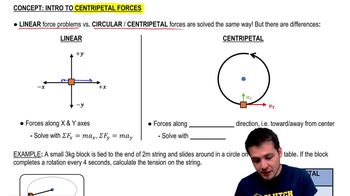
How fast (in rpm) must a centrifuge rotate if a particle 8.0 cm from the axis of rotation is to experience an acceleration of 100,000 g’s?
Verified step by step guidance
Verified video answer for a similar problem:
Key Concepts
Centripetal Acceleration
Gravitational Acceleration
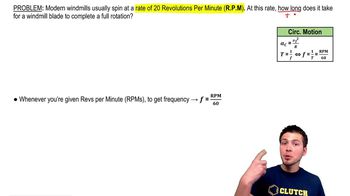
Revolutions Per Minute (RPM)
A turntable of radius R₁ is turned by a circular rubber roller of radius R₂ in contact with it at their outer edges. What is the ratio of their angular velocities, ω₁/ω₂?
(II) A child rolls a ball on a level floor 3.1 m to another child. If the ball makes 12.0 revolutions, what is its diameter?
The axle of a wheel is mounted on supports that rest on a rotating turntable as shown in Fig. 10–52. The wheel has angular velocity ω₁ = 48.0 rad/s about its axle, and the turntable has angular velocity ω₂ = 35.0 rad/s about a vertical axis. (Note arrows showing these motions in the figure? What is the resultant angular velocity of the wheel, as seen by an outside observer, at the instant shown? Give the magnitude and direction.
A child rolls a ball on a level floor 3.1 m to another child. If the ball makes 12.0 revolutions, what is its diameter?
The platter of the hard drive of a computer rotates at 7200 rpm (rpm = revolutions per minute = rev/min). If a single bit requires 0.50 μm of length along the direction of motion, how many bits per second can the writing head write when it is 3.00 cm from the axis?
