
Ch 06: Dynamics I: Motion Along a Line
Knight Calc - Physics for Scientists and Engineers 5th Edition
Knight Calc5th EditionPhysics for Scientists and EngineersISBN: 9780137344796Not the one you use?Change textbook
Chapter 6, Problem 9

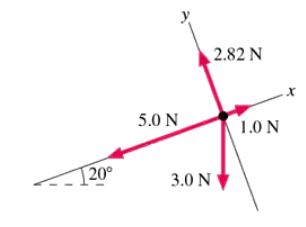
The forces in FIGURE EX6.9 act on a 2.0 kg object. What are the values of ax and ay, the x- and y-components of the object's acceleration?

Verified step by step guidance
1
Step 1: Identify the forces acting on the object. From the diagram, the forces are: 18 N upward, 10.7 N to the right, 10 N downward along the incline, and 12.3 N downward perpendicular to the incline. The incline is at an angle θ = 30°.
Step 2: Resolve the forces into components along the x-axis (parallel to the incline) and y-axis (perpendicular to the incline). For forces at an angle, use trigonometric functions: \( F_x = F \cos \theta \) and \( F_y = F \sin \theta \).
Step 3: Sum up the forces along the x-axis to find the net force \( F_{net,x} \). Include contributions from the 10.7 N force, the x-component of the 12.3 N force, and the x-component of the 10 N force. Use \( F_{net,x} = F_{10.7} + F_{12.3,x} - F_{10,x} \).
Step 4: Sum up the forces along the y-axis to find the net force \( F_{net,y} \). Include contributions from the 18 N force, the y-component of the 12.3 N force, and the y-component of the 10 N force. Use \( F_{net,y} = F_{18} - F_{12.3,y} - F_{10,y} \).
Step 5: Use Newton's second law \( F = ma \) to calculate the acceleration components \( a_x \) and \( a_y \). Divide the net forces by the mass of the object (2.0 kg): \( a_x = \frac{F_{net,x}}{m} \) and \( a_y = \frac{F_{net,y}}{m} \).

Verified video answer for a similar problem:

This video solution was recommended by our tutors as helpful for the problem above.
Video duration:
7m
Was this helpful?

Key Concepts

Here are the essential concepts you must grasp in order to answer the question correctly.

Newton's Second Law of Motion

Newton's Second Law states that the acceleration of an object is directly proportional to the net force acting on it and inversely proportional to its mass. This relationship is expressed by the equation F = ma, where F is the net force, m is the mass, and a is the acceleration. In this problem, understanding this law is crucial for calculating the acceleration components of the object based on the forces acting on it.
Recommended video:
Guided course
06:54
Intro to Forces & Newton's Second Law

Vector Resolution

Vector resolution involves breaking down a vector into its components along specified axes, typically the x and y axes. This is essential in physics to analyze forces acting at angles, as seen in the diagram. By resolving the forces into their components, we can apply Newton's Second Law to find the acceleration in each direction, which is necessary for solving the problem.
Recommended video:
Guided course
06:44
Adding 3 Vectors in Unit Vector Notation

Free Body Diagram (FBD)

A Free Body Diagram is a graphical representation that shows all the forces acting on an object. In this case, the FBD helps visualize the forces acting on the 2.0 kg object on the incline, including gravitational force, normal force, and applied forces. Analyzing the FBD is crucial for determining the net force and subsequently the acceleration components in the x and y directions.
Recommended video:
Guided course
08:42
Free-Body Diagrams