
Ch 06: Dynamics I: Motion Along a Line
Knight Calc - Physics for Scientists and Engineers 5th Edition
Knight Calc5th EditionPhysics for Scientists and EngineersISBN: 9780137344796Not the one you use?Change textbook
Chapter 6, Problem 10

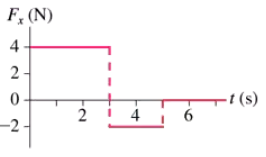
FIGURE EX6.10 shows the force acting on a 2.0 kg object as it moves along the x-axis. The object is at rest at the origin at t = 0 s. What are its acceleration and velocity at t = 6 s?

Verified step by step guidance
1
Step 1: Analyze the graph provided. The graph shows the force Fx (in Newtons) acting on the object as a function of time t (in seconds). The force is constant in three intervals: Fx = 6 N from t = 0 to t = 3 s, Fx = -3 N from t = 3 to t = 5 s, and Fx = 0 N from t = 5 to t = 6 s.
Step 2: Use Newton's second law of motion, F = ma, to calculate the acceleration in each interval. Since the mass of the object is given as 2.0 kg, the acceleration can be calculated as a = F/m. For example, in the first interval (t = 0 to t = 3 s), a = 6 N / 2.0 kg = 3 m/s².
Step 3: Determine the velocity at the end of each interval using the kinematic equation v = v₀ + aΔt, where v₀ is the initial velocity, a is the acceleration, and Δt is the time duration of the interval. Start with v₀ = 0 m/s at t = 0 s, and calculate the velocity for each interval sequentially.
Step 4: For the displacement during each interval, use the kinematic equation x = x₀ + v₀Δt + 0.5a(Δt)², where x₀ is the initial position (0 m in this case). This step is optional if only velocity and acceleration are required, but it helps understand the object's motion.
Step 5: Combine the results from all intervals to find the velocity and acceleration at t = 6 s. Note that the acceleration in the last interval (t = 5 to t = 6 s) is zero because Fx = 0 N. The velocity at t = 6 s will be the final velocity calculated from the previous intervals.

Verified video answer for a similar problem:

This video solution was recommended by our tutors as helpful for the problem above.
Video duration:
11m
Was this helpful?

Key Concepts

Here are the essential concepts you must grasp in order to answer the question correctly.

Newton's Second Law of Motion

Newton's Second Law states that the acceleration of an object is directly proportional to the net force acting on it and inversely proportional to its mass. This relationship is expressed by the formula F = ma, where F is the net force, m is the mass, and a is the acceleration. In this scenario, understanding this law is crucial to determine the acceleration of the 2.0 kg object based on the force applied over time.
Recommended video:
Guided course
06:54
Intro to Forces & Newton's Second Law

Kinematics

Kinematics is the branch of physics that describes the motion of objects without considering the forces that cause the motion. It involves concepts such as displacement, velocity, and acceleration. In this question, kinematic equations will be used to find the velocity of the object at t = 6 s, given its initial conditions and the acceleration derived from the force graph.
Recommended video:
Guided course
08:25
Kinematics Equations

Graph Interpretation

Interpreting graphs is essential in physics as they visually represent relationships between variables. In this case, the force vs. time graph provides information about how the force acting on the object changes over time, which can be integrated to find the impulse and subsequently the change in momentum. This understanding is key to calculating the object's acceleration and velocity at the specified time.
Recommended video:
Guided course
07:32
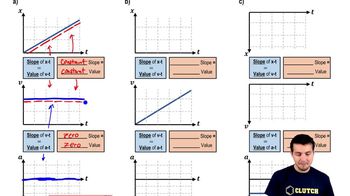
Graphing Position, Velocity, and Acceleration Graphs