Ch 06: Dynamics I: Motion Along a Line
Knight Calc - Physics for Scientists and Engineers 5th Edition
Knight Calc5th EditionPhysics for Scientists and EngineersISBN: 9780137344796Not the one you use?Change textbook
Chapter 6, Problem 12b

A horizontal rope is tied to a 50 kg box on frictionless ice. What is the tension in the rope if: The box moves at a steady 5.0 m/s?

Verified step by step guidance
1
Step 1: Begin by analyzing the forces acting on the box. Since the box is moving at a steady velocity (5.0 m/s), it is in dynamic equilibrium, meaning there is no net force acting on it. This implies that the tension in the rope is equal to the force required to overcome any resistance, but since the ice is frictionless, there is no resistance.
Step 2: Recall Newton's First Law of Motion, which states that an object in motion will remain in motion at a constant velocity unless acted upon by an external force. Since the box is moving at a steady velocity and there is no friction, the tension in the rope does not need to provide any additional force to maintain the motion.
Step 3: Understand that the tension in the rope is not required to accelerate the box because the velocity is constant. The acceleration (a) is zero, and Newton's Second Law, \( F = ma \), confirms that the net force is zero.
Step 4: Conclude that the tension in the rope is zero in this scenario because no force is needed to maintain the steady motion of the box on frictionless ice.
Step 5: Summarize the reasoning: The box moves at a constant velocity on frictionless ice, and no external force (including tension) is required to sustain this motion. Therefore, the tension in the rope is zero.

Verified video answer for a similar problem:

This video solution was recommended by our tutors as helpful for the problem above.
Video duration:
3m
Was this helpful?

Key Concepts

Here are the essential concepts you must grasp in order to answer the question correctly.

Newton's First Law of Motion

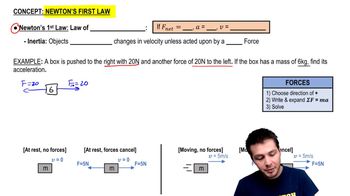
Newton's First Law states that an object at rest will remain at rest, and an object in motion will continue in motion at a constant velocity unless acted upon by a net external force. In this scenario, since the box is moving at a steady speed on frictionless ice, it indicates that the net force acting on it is zero, meaning the tension in the rope must balance any other forces acting on the box.
Recommended video:
Guided course
04:46
Newton's 1st Law

Tension in a Rope

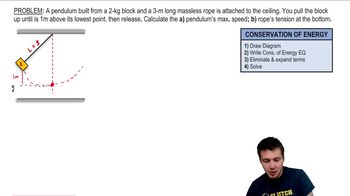
Tension is the force transmitted through a rope or string when it is pulled tight by forces acting from opposite ends. In this case, the tension in the rope is responsible for maintaining the box's steady motion. Since the box is moving at a constant speed, the tension must equal any opposing forces, which in this case is zero due to the absence of friction.
Recommended video:
Guided course
06:34
Calculating Tension in a Pendulum with Energy Conservation

Kinematics and Constant Velocity

Kinematics is the branch of mechanics that deals with the motion of objects without considering the forces that cause the motion. When an object moves at a constant velocity, its acceleration is zero, which implies that the net force acting on it is also zero. Therefore, in this scenario, the box's steady speed of 5.0 m/s indicates that the tension in the rope does not need to overcome any frictional forces, simplifying the analysis of the system.
Recommended video:
Guided course
08:59
Phase Constant of a Wave Function