Ch. 13 - Fluids
Giancoli Douglas - Physics for Scientists and Engineers 5th edition
Giancoli Douglas5th editionPhysics for Scientists and EngineersISBN: 9780137488179Not the one you use?Change textbook
Chapter 13, Problem 21b

An open-tube mercury manometer is used to measure the pressure in an oxygen tank. When the atmospheric pressure is 1040 mbar, what is the absolute pressure (in Pa) in the tank if the height of the mercury in the open tube is 7.6 cm lower than the mercury in the tube connected to the tank? See Fig. 13–10a.

Verified step by step guidance
1
Understand the problem: The goal is to calculate the absolute pressure in the oxygen tank. The manometer is an open-tube type, and the height difference of mercury between the two sides of the tube is given. Atmospheric pressure is provided in mbar, and the height difference is given in cm. We will use the relationship between pressure, height, and density to solve this.
Convert the atmospheric pressure from mbar to Pascals (Pa). Use the conversion factor: 1 mbar = 100 Pa. Therefore, atmospheric pressure \( P_{atm} \) in Pascals is \( P_{atm} = 1040 \times 100 \).
Determine the pressure contribution due to the height difference of mercury. The pressure difference \( \Delta P \) caused by the height difference is given by \( \Delta P = \rho g h \), where \( \rho \) is the density of mercury (\( 13,600 \ \text{kg/m}^3 \)), \( g \) is the acceleration due to gravity (\( 9.8 \ \text{m/s}^2 \)), and \( h \) is the height difference in meters. Convert the height from cm to meters: \( h = 7.6 \ \text{cm} = 0.076 \ \text{m} \).
Add the pressure contribution from the height difference to the atmospheric pressure to find the absolute pressure in the tank. Since the mercury level in the open tube is lower, the pressure in the tank is higher. The absolute pressure \( P_{abs} \) is given by \( P_{abs} = P_{atm} + \Delta P \). Substitute the values for \( P_{atm} \) and \( \Delta P \) into this equation.
Express the final result in Pascals (Pa). Ensure all units are consistent throughout the calculation. The absolute pressure in the tank is the sum of the atmospheric pressure and the pressure contribution from the mercury column.

Verified video answer for a similar problem:

This video solution was recommended by our tutors as helpful for the problem above.
Video duration:
3m
Was this helpful?

Key Concepts

Here are the essential concepts you must grasp in order to answer the question correctly.

Manometer Principles

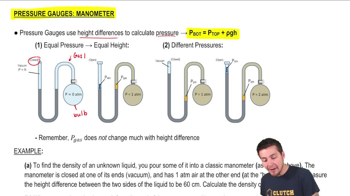
A manometer is a device used to measure pressure by balancing a column of liquid against the pressure to be measured. In an open-tube manometer, the difference in height between two columns of liquid (usually mercury) indicates the pressure difference between the gas in the tank and the atmospheric pressure. The height difference is directly related to the pressure difference, allowing for calculations of absolute pressure.
Recommended video:
Guided course
10:40
Pressure Gauges: Manometer

Absolute Pressure

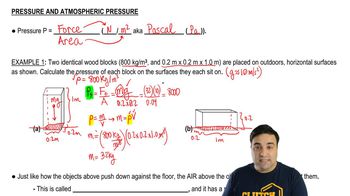
Absolute pressure is the total pressure exerted on a system, measured relative to a perfect vacuum. It is calculated by adding the atmospheric pressure to the gauge pressure (the pressure relative to atmospheric pressure). In this scenario, the absolute pressure in the oxygen tank can be determined by considering the height difference in the mercury columns and the known atmospheric pressure.
Recommended video:
Guided course
17:04
Pressure and Atmospheric Pressure

Pressure Conversion

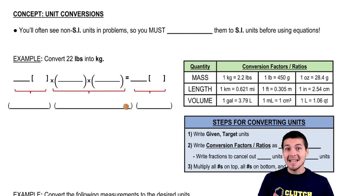
Pressure is often measured in various units, such as pascals (Pa), millibars (mbar), and atmospheres (atm). To convert between these units, it is essential to know the relationships: 1 mbar equals 100 Pa. In this problem, converting the atmospheric pressure from mbar to Pa is necessary to find the absolute pressure in the tank accurately.
Recommended video:
Guided course
07:46
Unit Conversions