Ch. 13 - Fluids
Giancoli Douglas - Physics for Scientists and Engineers 5th edition
Giancoli Douglas5th editionPhysics for Scientists and EngineersISBN: 9780137488179Not the one you use?Change textbook
Chapter 13, Problem 39

How many helium-filled balloons would it take to lift a person? Assume the person has a mass of 72 kg and that each helium-filled balloon is spherical with a diameter of 36 cm.

Verified step by step guidance
1
Determine the weight of the person in newtons using the formula for weight: \( W = m \cdot g \), where \( m \) is the mass of the person (72 kg) and \( g \) is the acceleration due to gravity (approximately 9.8 m/s²).
Calculate the volume of a single helium-filled balloon. Since the balloon is spherical, use the formula for the volume of a sphere: \( V = \frac{4}{3} \pi r^3 \), where \( r \) is the radius of the balloon. The radius is half the diameter, so \( r = 36 \text{ cm} / 2 = 18 \text{ cm} = 0.18 \text{ m} \).
Determine the buoyant force provided by a single helium-filled balloon using Archimedes' principle: \( F_b = \rho_{air} \cdot V \cdot g \), where \( \rho_{air} \) is the density of air (approximately 1.225 kg/m³), \( V \) is the volume of the balloon, and \( g \) is the acceleration due to gravity.
Account for the weight of the helium inside the balloon. The mass of the helium can be calculated using \( m_{He} = \rho_{He} \cdot V \), where \( \rho_{He} \) is the density of helium (approximately 0.1786 kg/m³). The weight of the helium is then \( W_{He} = m_{He} \cdot g \). Subtract this weight from the buoyant force to find the net lifting force of a single balloon.
Divide the total weight of the person (calculated in step 1) by the net lifting force of a single balloon (calculated in step 4) to determine the number of balloons required. Round up to the nearest whole number, as partial balloons are not possible.

Verified video answer for a similar problem:

This video solution was recommended by our tutors as helpful for the problem above.
Video duration:
9m
Was this helpful?

Key Concepts

Here are the essential concepts you must grasp in order to answer the question correctly.

Buoyancy

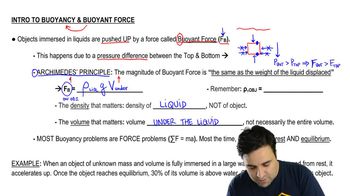
Buoyancy is the upward force exerted by a fluid that opposes the weight of an object immersed in it. This principle, described by Archimedes' principle, states that the buoyant force on an object is equal to the weight of the fluid displaced by the object. In the context of helium balloons, the buoyant force must be sufficient to lift the weight of the person.
Recommended video:
Guided course
11:06
Intro to Buoyancy & Buoyant Force

Weight of Helium

The weight of helium is crucial in determining how many balloons are needed to lift a person. Helium is lighter than air, which allows it to create lift. The lifting capacity of a single helium balloon can be calculated by finding the difference between the weight of the air displaced by the balloon and the weight of the helium inside it.
Recommended video:
Guided course
10:19
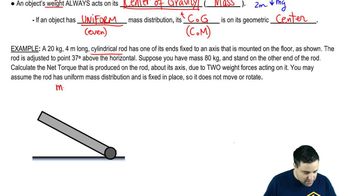
Torque Due to Weight

Volume of a Balloon

The volume of a balloon is essential for calculating how much air it displaces, which directly affects its buoyancy. For a spherical balloon, the volume can be calculated using the formula V = (4/3)πr³, where r is the radius. Knowing the volume allows us to determine the amount of lift generated by each balloon, which is necessary to find out how many balloons are required to lift a person.
Recommended video:
Guided course
03:40
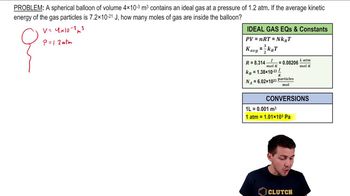
Gas in a Balloon