
Ch. 13 - Fluids
Giancoli Douglas - Physics for Scientists and Engineers 5th edition
Giancoli Douglas5th editionPhysics for Scientists and EngineersISBN: 9780137488179Not the one you use?Change textbook
Chapter 13, Problem 47

What is the volume rate of flow of water from a 1.85-cm-diameter faucet if the pressure head is 12.0 m?

Verified step by step guidance
1
Convert the diameter of the faucet into radius in meters. The radius is half the diameter, so divide the given diameter (1.85 cm) by 2 and then convert it to meters by dividing by 100.
Use the Bernoulli equation to relate the pressure head to the velocity of the water. The pressure head (h) is given as 12.0 m, and the velocity (v) can be calculated using the formula: 2gh, where g is the acceleration due to gravity (9.8 m/s²).
Calculate the cross-sectional area of the faucet using the formula for the area of a circle: A = πr2, where r is the radius of the faucet in meters.
Determine the volume rate of flow (Q) using the formula: Q = Av, where A is the cross-sectional area and v is the velocity of the water.
Substitute the values for A and v into the formula for Q to find the volume rate of flow. Ensure all units are consistent (meters, seconds, etc.) before performing the calculation.

Verified video answer for a similar problem:

This video solution was recommended by our tutors as helpful for the problem above.
Video duration:
10m
Was this helpful?

Key Concepts

Here are the essential concepts you must grasp in order to answer the question correctly.

Bernoulli's Principle

Bernoulli's Principle states that in a flowing fluid, an increase in the fluid's speed occurs simultaneously with a decrease in pressure or potential energy. This principle helps explain how pressure differences can drive fluid flow, which is essential for understanding how water exits a faucet under pressure.
Recommended video:
Guided course
14:47
Diffraction with Huygen's Principle

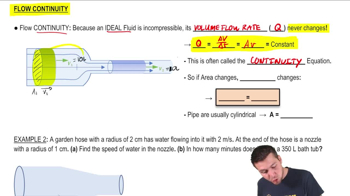
Continuity Equation

The Continuity Equation is a fundamental principle in fluid dynamics that states that the mass flow rate must remain constant from one cross-section of a pipe to another. For incompressible fluids, this means that the product of the cross-sectional area and the flow velocity is constant, allowing us to relate the diameter of the faucet to the flow rate.
Recommended video:
Guided course
11:08
Flow Continuity

Flow Rate

Flow rate is the volume of fluid that passes through a given surface per unit time, typically measured in liters per second or cubic meters per second. In this context, calculating the flow rate from the faucet involves using the pressure head and the diameter of the faucet to determine how much water is flowing out over time.
Recommended video:
Guided course
6:34
Fluid Speed & Volume Flow Rate