
Ch. 13 - Fluids
Giancoli Douglas - Physics for Scientists and Engineers 5th edition
Giancoli Douglas5th editionPhysics for Scientists and EngineersISBN: 9780137488179Not the one you use?Change textbook
Chapter 13, Problem 48

A fish tank has dimensions 36 cm wide by 1.0 m long by 0.60 m high. If the filter should process all the water in the tank once every 2.5 h, what should the flow speed be in the 3.0-cm-diameter input tube for the filter?

Verified step by step guidance
1
Calculate the volume of the fish tank. The volume is given by the product of its dimensions: \( V = \text{width} \times \text{length} \times \text{height} \). Convert all dimensions to meters before calculating. For example, the width is \( 36 \; \text{cm} = 0.36 \; \text{m} \).
Determine the flow rate required to process the entire volume of water in the tank every 2.5 hours. The flow rate \( Q \) is given by \( Q = \frac{V}{t} \), where \( V \) is the volume of the tank and \( t \) is the time in seconds (convert 2.5 hours to seconds: \( t = 2.5 \times 3600 \; \text{s} \)).
Relate the flow rate \( Q \) to the flow speed \( v \) in the input tube using the equation \( Q = A \cdot v \), where \( A \) is the cross-sectional area of the tube. The area \( A \) of a circular tube is given by \( A = \pi r^2 \), where \( r \) is the radius of the tube. The diameter of the tube is 3.0 cm, so \( r = \frac{3.0}{2} \; \text{cm} = 0.015 \; \text{m} \).
Rearrange the equation \( Q = A \cdot v \) to solve for the flow speed \( v \): \( v = \frac{Q}{A} \). Substitute the values of \( Q \) (from step 2) and \( A \) (from step 3) into this equation.
Perform the calculations to find the flow speed \( v \). Ensure that all units are consistent (e.g., meters, seconds) throughout the calculations.

Verified video answer for a similar problem:

This video solution was recommended by our tutors as helpful for the problem above.
Video duration:
5m
Was this helpful?

Key Concepts

Here are the essential concepts you must grasp in order to answer the question correctly.

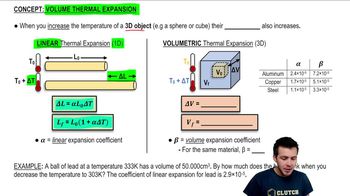
Volume of the Tank

To determine the flow speed required for the filter, we first need to calculate the volume of the fish tank. The volume can be found using the formula V = width × length × height. In this case, the dimensions must be converted to consistent units, and the volume will be expressed in cubic meters or liters, which is essential for understanding how much water needs to be processed.
Recommended video:
Guided course
05:21
Volume Thermal Expansion

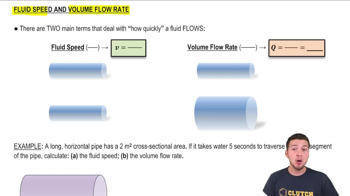
Flow Rate

Flow rate is the volume of fluid that passes through a given surface per unit time. It is typically measured in liters per hour or cubic meters per second. For this problem, we need to calculate the flow rate required to process the entire volume of the tank in the specified time of 2.5 hours, which will help us determine the necessary speed of the water in the input tube.
Recommended video:
Guided course
6:34
Fluid Speed & Volume Flow Rate

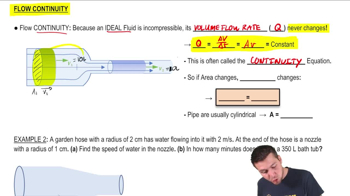
Continuity Equation

The continuity equation in fluid dynamics states that the mass flow rate must remain constant from one cross-section of a pipe to another. For incompressible fluids, this can be simplified to A1V1 = A2V2, where A is the cross-sectional area and V is the flow speed. This principle will be used to relate the flow speed in the input tube to the flow rate calculated from the tank's volume and processing time.
Recommended video:
Guided course
11:08
Flow Continuity