Ch. 13 - Fluids
Giancoli Douglas - Physics for Scientists and Engineers 5th edition
Giancoli Douglas5th editionPhysics for Scientists and EngineersISBN: 9780137488179Not the one you use?Change textbook
Chapter 13, Problem 32

Calculate the true mass (in vacuum) of an aluminum sphere whose apparent mass is 4.0000 kg when weighed in air.

Verified step by step guidance
1
Understand the problem: The apparent mass of the aluminum sphere is given as 4.0000 kg when weighed in air. This means the buoyant force exerted by the air affects the measurement. To find the true mass (in vacuum), we need to account for this buoyant force.
Recall the formula for the apparent mass: \( m_{apparent} = m_{true} - F_b / g \), where \( F_b \) is the buoyant force and \( g \) is the acceleration due to gravity. Rearrange this to solve for the true mass: \( m_{true} = m_{apparent} + F_b / g \).
Determine the buoyant force: The buoyant force is given by \( F_b = \rho_{air} V g \), where \( \rho_{air} \) is the density of air, \( V \) is the volume of the sphere, and \( g \) is the acceleration due to gravity. To find \( V \), use the relationship \( V = m_{apparent} / \rho_{aluminum} \), where \( \rho_{aluminum} \) is the density of aluminum.
Substitute \( V \) into the buoyant force equation: \( F_b = \rho_{air} (m_{apparent} / \rho_{aluminum}) g \). Simplify this to \( F_b = (\rho_{air} / \rho_{aluminum}) m_{apparent} g \).
Finally, substitute \( F_b \) into the true mass equation: \( m_{true} = m_{apparent} + (\rho_{air} / \rho_{aluminum}) m_{apparent} \). Simplify this expression to calculate the true mass of the aluminum sphere in vacuum.

Verified video answer for a similar problem:

This video solution was recommended by our tutors as helpful for the problem above.
Video duration:
8m
Was this helpful?

Key Concepts

Here are the essential concepts you must grasp in order to answer the question correctly.

Buoyancy

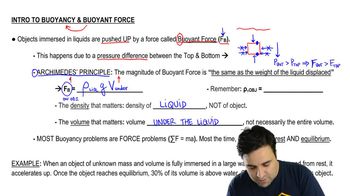
Buoyancy is the upward force exerted by a fluid that opposes the weight of an object immersed in it. This force is responsible for the apparent loss of weight when an object is weighed in a fluid, such as air or water. The buoyant force depends on the density of the fluid and the volume of the displaced fluid, which is crucial for understanding how the apparent mass differs from the true mass.
Recommended video:
Guided course
11:06
Intro to Buoyancy & Buoyant Force

Archimedes' Principle

Archimedes' Principle states that an object submerged in a fluid experiences a buoyant force equal to the weight of the fluid it displaces. This principle helps explain why the apparent mass of an object, like the aluminum sphere, is less than its true mass when weighed in air. Understanding this principle is essential for calculating the true mass from the apparent mass.
Recommended video:
Guided course
14:47
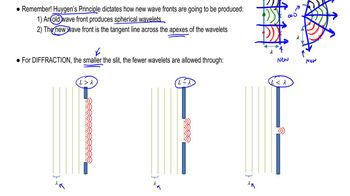
Diffraction with Huygen's Principle

Density

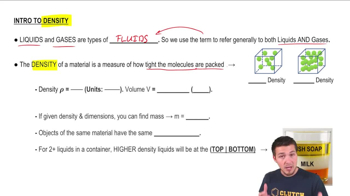
Density is defined as mass per unit volume and is a key property of materials. It influences how much buoyant force an object experiences when submerged in a fluid. For the aluminum sphere, knowing its density allows for the calculation of its true mass based on the apparent mass measured in air, as the difference is due to the buoyant force acting on it.
Recommended video:
Guided course
8:13
Intro to Density