Ch. 13 - Fluids
Giancoli Douglas - Physics for Scientists and Engineers 5th edition
Giancoli Douglas5th editionPhysics for Scientists and EngineersISBN: 9780137488179Not the one you use?Change textbook
Chapter 13, Problem 16b

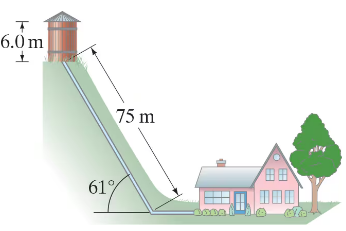
A house at the bottom of a hill is fed by a full tank of water 6.0 m deep and connected to the house by a pipe that is 75 m long at an angle of 61° from the horizontal (Fig. 13–53). How high could the water shoot if it came vertically out of a broken pipe in front of the house?

Verified step by step guidance
1
Determine the pressure at the bottom of the water tank using the hydrostatic pressure formula: \( P = \rho g h \), where \( \rho \) is the density of water (approximately \( 1000 \; \text{kg/m}^3 \)), \( g \) is the acceleration due to gravity (\( 9.8 \; \text{m/s}^2 \)), and \( h \) is the depth of the water (6.0 m).
Account for the pressure due to the height difference between the tank and the house. The vertical height of the pipe can be calculated using trigonometry: \( h_{\text{vertical}} = 75 \; \text{m} \times \sin(61^\circ) \). Add this height to the depth of the water in the tank to find the total effective height.
Use Bernoulli's equation to relate the pressure at the tank to the velocity of the water exiting the broken pipe. Bernoulli's equation is \( P + \frac{1}{2} \rho v^2 + \rho g h = \text{constant} \). Assume the velocity of water at the tank is negligible and solve for the velocity \( v \) of the water exiting the pipe.
Determine the maximum height the water could reach if it shoots vertically upward. Use the kinematic equation \( h_{\text{max}} = \frac{v^2}{2g} \), where \( v \) is the velocity of the water exiting the pipe and \( g \) is the acceleration due to gravity.
Combine all the calculated values to find the maximum height the water could reach. Ensure all units are consistent throughout the calculations.

Verified video answer for a similar problem:

This video solution was recommended by our tutors as helpful for the problem above.
Video duration:
2m
Was this helpful?

Key Concepts

Here are the essential concepts you must grasp in order to answer the question correctly.

Hydrostatic Pressure

Hydrostatic pressure is the pressure exerted by a fluid at equilibrium due to the force of gravity. It increases with depth in a fluid, calculated using the formula P = ρgh, where P is pressure, ρ is the fluid density, g is the acceleration due to gravity, and h is the height of the fluid column. In this scenario, the depth of the water tank (6.0 m) contributes to the pressure at the pipe's outlet.
Recommended video:
Guided course
17:04
Pressure and Atmospheric Pressure

Bernoulli's Principle

Bernoulli's Principle states that in a flowing fluid, an increase in velocity occurs simultaneously with a decrease in pressure or potential energy. This principle helps explain how the water can shoot out of the broken pipe. The potential energy from the height of the water in the tank is converted into kinetic energy as the water exits the pipe, determining how high it can rise.
Recommended video:
Guided course
14:47
Diffraction with Huygen's Principle

Projectile Motion

Projectile motion refers to the motion of an object that is thrown or projected into the air, subject to gravitational acceleration. When the water exits the broken pipe vertically, it behaves like a projectile, and its maximum height can be calculated using kinematic equations. The initial velocity of the water, derived from the pressure at the outlet, will determine how high it can rise before gravity pulls it back down.
Recommended video:
Guided course
04:44
Introduction to Projectile Motion