Ch. 08 - Conservation of Energy
Giancoli Douglas - Physics for Scientists and Engineers 5th edition
Giancoli Douglas5th editionPhysics for Scientists and EngineersISBN: 9780137488179Not the one you use?Change textbook
Chapter 8, Problem 62

A driver notices that her 950-kg car, when in neutral, slows down from 95 km/h to 65 km/h in about 7.0 s on a flat horizontal road. Approximately what power (watts and hp) is needed to keep the car traveling at a constant 80 km/h?

Verified step by step guidance
1
Convert all given speeds from km/h to m/s. Use the conversion factor: 1 km/h = 1000 m / 3600 s. For example, \( v = 95 \text{ km/h} \) becomes \( v = \frac{95 \times 1000}{3600} \text{ m/s} \). Perform similar conversions for 65 km/h and 80 km/h.
Calculate the deceleration (negative acceleration) of the car while it slows down. Use the kinematic equation \( a = \frac{v_f - v_i}{t} \), where \( v_f \) is the final velocity, \( v_i \) is the initial velocity, and \( t \) is the time interval.
Determine the resistive force acting on the car due to friction and air resistance. Use Newton's second law: \( F = ma \), where \( m \) is the mass of the car and \( a \) is the deceleration calculated in the previous step.
Calculate the power required to overcome this resistive force and maintain a constant speed of 80 km/h. Use the formula for power: \( P = Fv \), where \( F \) is the resistive force and \( v \) is the constant velocity (in m/s).
Convert the power from watts to horsepower (hp) using the conversion factor: \( 1 \text{ hp} = 746 \text{ W} \).

Verified video answer for a similar problem:

This video solution was recommended by our tutors as helpful for the problem above.
Was this helpful?

Key Concepts

Here are the essential concepts you must grasp in order to answer the question correctly.

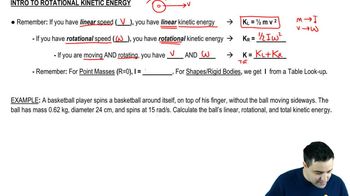
Kinetic Energy

Kinetic energy is the energy an object possesses due to its motion, calculated using the formula KE = 1/2 mv², where m is mass and v is velocity. In this scenario, understanding the kinetic energy of the car at different speeds is crucial for determining the energy required to maintain a constant speed against resistive forces.
Recommended video:
Guided course
06:07
Intro to Rotational Kinetic Energy

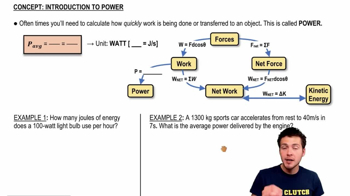
Power

Power is the rate at which work is done or energy is transferred, expressed in watts (W) in the SI system. It can be calculated using the formula P = W/t, where W is work done and t is time. In this context, calculating the power needed to maintain a constant speed involves understanding the work done against forces like friction and air resistance.
Recommended video:

Forces Acting on the Car

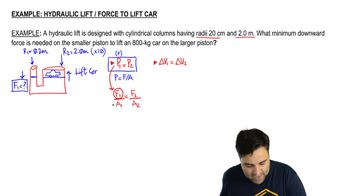
When a car is in motion, various forces act upon it, including gravitational force, friction, and air resistance. To maintain a constant speed, the power output must counteract these forces. Analyzing these forces helps in determining the net force required to keep the car moving at 80 km/h, which is essential for calculating the necessary power.
Recommended video:
Guided course
05:13
Force to Lift a Car