
Ch. 08 - Conservation of Energy
Giancoli Douglas - Physics for Scientists and Engineers 5th edition
Giancoli Douglas5th editionPhysics for Scientists and EngineersISBN: 9780137488179Not the one you use?Change textbook
Chapter 8, Problem 69c

The position of a 280-g object is given (in meters) by x = 4.0t³ - 8.0t² - 44t, where t is in seconds. What is the average net power input during the interval from t = 0s to t = 2.0 s, and in the interval from t = 2.0 s to 4.0 s?

Verified step by step guidance
1
Step 1: Understand the problem. The position of the object is given as a function of time: x(t) = 4.0t³ - 8.0t² - 44t (in meters). The goal is to calculate the average net power input during two time intervals: t = 0s to t = 2.0s, and t = 2.0s to t = 4.0s. Power is related to the rate of work done, which depends on force and velocity.
Step 2: Calculate the velocity as a function of time by differentiating the position function x(t) with respect to time t. Use the formula: v(t) = dx/dt. Differentiate x(t) = 4.0t³ - 8.0t² - 44t to get v(t).
Step 3: Calculate the acceleration as a function of time by differentiating the velocity function v(t) with respect to time t. Use the formula: a(t) = dv/dt. Differentiate the velocity function obtained in Step 2 to get a(t).
Step 4: Determine the force acting on the object as a function of time using Newton's second law: F(t) = m * a(t), where m is the mass of the object (280 g = 0.280 kg). Substitute the acceleration function a(t) into this equation to find F(t).
Step 5: Calculate the instantaneous power as a function of time using the formula: P(t) = F(t) * v(t). Then, find the average power over each time interval by integrating P(t) over the interval and dividing by the duration of the interval. Use the formula: P_avg = (1/Δt) * ∫[t₁ to t₂] P(t) dt, where Δt = t₂ - t₁. Perform this calculation for both intervals: t = 0s to t = 2.0s, and t = 2.0s to t = 4.0s.

Verified video answer for a similar problem:

This video solution was recommended by our tutors as helpful for the problem above.
Was this helpful?

Key Concepts

Here are the essential concepts you must grasp in order to answer the question correctly.

Kinematics

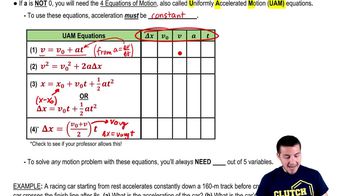
Kinematics is the branch of mechanics that describes the motion of objects without considering the forces that cause the motion. It involves concepts such as position, velocity, and acceleration, which are essential for analyzing the motion of the 280-g object described by the position function x(t). Understanding kinematics allows us to derive the object's velocity and acceleration from its position function.
Recommended video:
Guided course
08:25
Kinematics Equations

Power

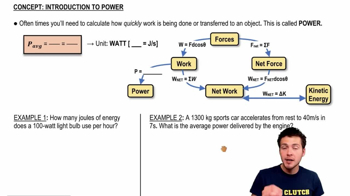
Power is defined as the rate at which work is done or energy is transferred over time. In the context of physics, average power can be calculated by dividing the work done by the time interval during which the work is performed. For the given problem, calculating the average net power input requires determining the work done on the object over the specified time intervals and dividing it by the duration of those intervals.
Recommended video:

Work-Energy Principle

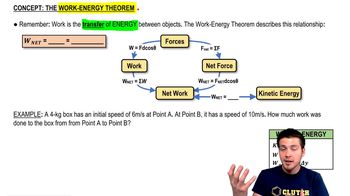
The Work-Energy Principle states that the work done on an object is equal to the change in its kinetic energy. This principle is crucial for solving problems involving power, as it allows us to relate the net work done on the object to its motion. By applying this principle, we can calculate the work done during the specified time intervals and subsequently determine the average net power input.
Recommended video:
Guided course
04:10
The Work-Energy Theorem
Related Practice
Textbook Question

A driver notices that her 950-kg car, when in neutral, slows down from 95 km/h to 65 km/h in about 7.0 s on a flat horizontal road. Approximately what power (watts and hp) is needed to keep the car traveling at a constant 80 km/h?

2
views
Textbook Question

An 85-kg football player traveling 5.0 m/s is stopped in 1.0 s by a tackler. What average power is required to stop him?

1
views
Textbook Question

The graph of Fig. 8–43 shows the potential energy curve of a particle moving along the 𝓍 axis under the influence of a conservative force. Note that the total energy E > U(𝓍), so that the particle’s speed is never zero. In which interval(s) of 𝓍 is the force on the particle to the right?

1
views
Textbook Question

The potential energy of the two atoms in a diatomic (two-atom) molecule can be approximated as (Lennard-Jones potential) U(r) = -(a/r⁶) + (b/r¹²), where r is the distance between the two atoms and a and b are positive constants. At what values of r is U(r) a minimum? A maximum?

2
views
Textbook Question

The graph of Fig. 8–43 shows the potential energy curve of a particle moving along the 𝓍 axis under the influence of a conservative force. Note that the total energy E > U(𝓍), so that the particle’s speed is never zero. At what value(s) of 𝓍 is the magnitude of the force a minimum?

1
views
Textbook Question

Determine the escape velocity from the Sun for an object at the average distance of the Earth (1.50 x 10⁸ km). Compare (give factor for each) to the speed of the Earth in its orbit.

3
views