
A driver notices that her 950-kg car, when in neutral, slows down from 95 km/h to 65 km/h in about 7.0 s on a flat horizontal road. Approximately what power (watts and hp) is needed to keep the car traveling at a constant 80 km/h?
An 85-kg football player traveling 5.0 m/s is stopped in 1.0 s by a tackler. What average power is required to stop him?
Verified step by step guidance
Verified video answer for a similar problem:
Key Concepts
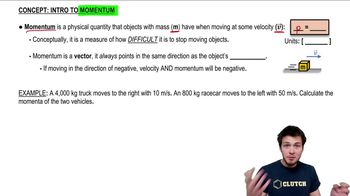
Momentum
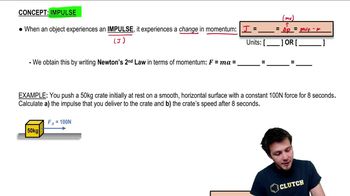
Impulse
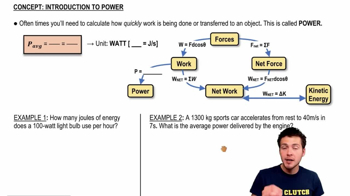
Power
The graph of Fig. 8–43 shows the potential energy curve of a particle moving along the 𝓍 axis under the influence of a conservative force. Note that the total energy E > U(𝓍), so that the particle’s speed is never zero. In which interval(s) of 𝓍 is the force on the particle to the right?
Early test flights for the space shuttle used a “glider” (mass of 980 kg including pilot). After a horizontal launch at 480 km/h at a height of 3200 m, the glider eventually landed at sea level with a speed of 210 km/h. What would its landing speed have been in the absence of air resistance?
The position of a 280-g object is given (in meters) by x = 4.0t³ - 8.0t² - 44t, where t is in seconds. What is the average net power input during the interval from t = 0s to t = 2.0 s, and in the interval from t = 2.0 s to 4.0 s?
Determine the escape velocity from the Sun for an object at the average distance of the Earth (1.50 x 10⁸ km). Compare (give factor for each) to the speed of the Earth in its orbit.
Determine the escape velocity from the Sun for an object at the Sun’s surface ( r = 7.0 x 10⁵ km , M = 2.0 x 10³⁰ kg).
