Ch. 08 - Conservation of Energy
Giancoli Douglas - Physics for Scientists and Engineers 5th edition
Giancoli Douglas5th editionPhysics for Scientists and EngineersISBN: 9780137488179Not the one you use?Change textbook
Chapter 8, Problem 40a

Early test flights for the space shuttle used a “glider” (mass of 980 kg including pilot). After a horizontal launch at 480 km/h at a height of 3200 m, the glider eventually landed at sea level with a speed of 210 km/h. What would its landing speed have been in the absence of air resistance?

Verified step by step guidance
1
Convert all given speeds from km/h to m/s for consistency in SI units. Use the conversion factor: \(1 \ \text{km/h} = \frac{1000}{3600} \ \text{m/s}\). For example, \(v_\text{initial} = 480 \ \text{km/h} \times \frac{1000}{3600}\) and \(v_\text{final} = 210 \ \text{km/h} \times \frac{1000}{3600}\).
Apply the principle of conservation of mechanical energy, assuming no air resistance. The total mechanical energy at the initial point (launch) is the sum of kinetic energy \(KE\) and potential energy \(PE\): \(E_\text{initial} = \frac{1}{2} m v_\text{initial}^2 + m g h\), where \(m\) is the mass of the glider, \(g\) is the acceleration due to gravity (\(9.8 \ \text{m/s}^2\)), and \(h\) is the height (3200 m).
At the landing point (sea level), the potential energy is zero because \(h = 0\). The total mechanical energy is purely kinetic: \(E_\text{final} = \frac{1}{2} m v_\text{final}^2\).
Set the initial total energy equal to the final total energy to solve for the landing speed in the absence of air resistance: \(\frac{1}{2} m v_\text{initial}^2 + m g h = \frac{1}{2} m v_\text{final}^2\). Notice that the mass \(m\) cancels out from all terms.
Rearrange the equation to solve for \(v_\text{final}\): \(v_\text{final} = \sqrt{v_\text{initial}^2 + 2 g h}\). Substitute the known values for \(v_\text{initial}\), \(g\), and \(h\) to calculate the landing speed in the absence of air resistance.

Verified video answer for a similar problem:

This video solution was recommended by our tutors as helpful for the problem above.
Video duration:
8m
Was this helpful?

Key Concepts

Here are the essential concepts you must grasp in order to answer the question correctly.

Conservation of Energy

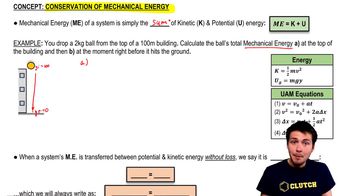
The principle of conservation of energy states that the total energy in a closed system remains constant. In the context of the glider, the potential energy at its initial height is converted into kinetic energy as it descends. This relationship allows us to calculate the theoretical landing speed by equating the initial potential energy to the kinetic energy at sea level, assuming no energy is lost to air resistance.
Recommended video:
Guided course
06:24
Conservation Of Mechanical Energy

Kinetic Energy

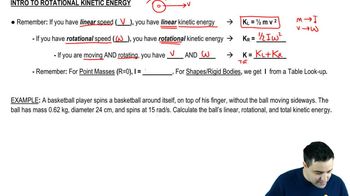
Kinetic energy is the energy an object possesses due to its motion, calculated using the formula KE = 1/2 mv², where m is mass and v is velocity. For the glider, its kinetic energy at landing can be determined by its speed just before impact. Understanding kinetic energy is crucial for determining how speed changes as the glider descends and accelerates towards the ground.
Recommended video:
Guided course
06:07
Intro to Rotational Kinetic Energy

Potential Energy

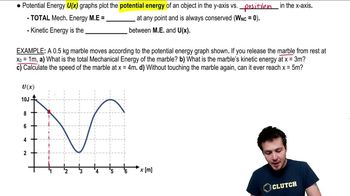
Potential energy is the stored energy of an object due to its position in a gravitational field, calculated using the formula PE = mgh, where m is mass, g is the acceleration due to gravity, and h is height. In this scenario, the glider's initial potential energy at 3200 m is converted into kinetic energy as it descends, which is essential for calculating the speed it would have landed at without air resistance.
Recommended video:
Guided course
07:24
Potential Energy Graphs
Related Practice
Textbook Question

An 85-kg football player traveling 5.0 m/s is stopped in 1.0 s by a tackler. What average power is required to stop him?

1
views
Textbook Question

A spring ( k = 75 N/m) has an equilibrium length of 1.00 m. The spring is compressed to a length of 0.50 m and a mass of 2.0 kg is placed at its free end on a frictionless slope which makes an angle of 41° with respect to the horizontal (Fig. 8–41). The spring is then released. Now the incline has a coefficient of kinetic friction μₖ. If the block, attached to the spring, is observed to stop just as it reaches the spring’s equilibrium position, what is the coefficient of friction μₖ?

1
views
Textbook Question

Determine the escape velocity from the Sun for an object at the average distance of the Earth (1.50 x 10⁸ km). Compare (give factor for each) to the speed of the Earth in its orbit.

3
views
Textbook Question

Determine the escape velocity from the Sun for an object at the Sun’s surface ( r = 7.0 x 10⁵ km , M = 2.0 x 10³⁰ kg).

2
views
Textbook Question

A spring ( k = 75 N/m) has an equilibrium length of 1.00 m. The spring is compressed to a length of 0.50 m and a mass of 2.0 kg is placed at its free end on a frictionless slope which makes an angle of 41° with respect to the horizontal (Fig. 8–41). The spring is then released. If the mass is attached to the spring, how far up the slope will the mass move before coming to rest?

1
views
Textbook Question

Consider the track shown in Fig. 8–39. The section AB is one quadrant of a circle of radius 2.0 m and is frictionless. B to C is a horizontal span 3.0 m long with a coefficient of kinetic friction μₖ = 0.25. The section CD under the spring is frictionless. A block of mass 1.0 kg is released from rest at A. After sliding on the track, it compresses the spring by 0.20 m. Determine the stiffness constant k for the spring.