
Ch. 08 - Conservation of Energy
Giancoli Douglas - Physics for Scientists and Engineers 5th edition
Giancoli Douglas5th editionPhysics for Scientists and EngineersISBN: 9780137488179Not the one you use?Change textbook
Chapter 8, Problem 73b

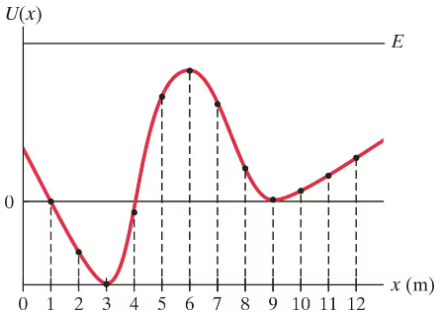
The graph of Fig. 8–43 shows the potential energy curve of a particle moving along the 𝓍 axis under the influence of a conservative force. Note that the total energy E > U(𝓍), so that the particle’s speed is never zero. At what value(s) of 𝓍 is the magnitude of the force a minimum?
Graph showing potential energy U(x) versus position x, with total energy E indicated, highlighting force minima points.

Verified step by step guidance
1
Step 1: Understand the relationship between force and potential energy. The force acting on a particle in a conservative field is related to the potential energy by the equation: F=-dUdx. This means the force is the negative gradient (slope) of the potential energy curve.
Step 2: Analyze the graph of the potential energy curve. The magnitude of the force is minimum when the slope of the potential energy curve is closest to zero, i.e., when the curve is flat or has a local extremum (minimum or maximum).
Step 3: Identify the points on the graph where the slope of the potential energy curve is zero. These are the points where the tangent to the curve is horizontal. Look for these points visually on the graph provided in the problem.
Step 4: Verify that the total energy E is greater than the potential energy U(x) at these points. This ensures that the particle is physically allowed to be at these positions, as the total energy must always be greater than or equal to the potential energy.
Step 5: Conclude that the magnitude of the force is minimum at the values of 𝓍 where the slope of the potential energy curve is zero, and the particle is allowed to exist based on the total energy condition.

Verified video answer for a similar problem:

This video solution was recommended by our tutors as helpful for the problem above.
Video duration:
2m
Was this helpful?

Key Concepts

Here are the essential concepts you must grasp in order to answer the question correctly.

Potential Energy Curve

A potential energy curve represents the potential energy of a particle as a function of its position along a given axis. It illustrates how the potential energy changes with position, indicating regions where the particle can move freely and where it may be trapped. The shape of the curve is crucial for understanding the forces acting on the particle, as it helps identify points of stable and unstable equilibrium.
Recommended video:
Guided course
01:57
Potential Energy Graph of a Marble

Conservative Force

A conservative force is a force that does work on an object in such a way that the total mechanical energy of the system remains constant. This means that the work done by the force depends only on the initial and final positions of the object, not on the path taken. Examples include gravitational and electrostatic forces, which can be derived from a potential energy function.
Recommended video:
Guided course
06:43
Energy Conservation with Non-Conservative Forces

Force and Its Relation to Potential Energy

The force acting on a particle can be derived from the potential energy curve using the relationship F(x) = -dU/dx, where F is the force and U is the potential energy. This means that the force is related to the slope of the potential energy curve; points where the slope is zero correspond to points of minimum or maximum force. To find the minimum magnitude of the force, one must identify the points where the potential energy curve has a local extremum.
Recommended video:
Guided course
07:24
Potential Energy Graphs
Related Practice
Textbook Question

A driver notices that her 950-kg car, when in neutral, slows down from 95 km/h to 65 km/h in about 7.0 s on a flat horizontal road. Approximately what power (watts and hp) is needed to keep the car traveling at a constant 80 km/h?

2
views
Textbook Question

The graph of Fig. 8–43 shows the potential energy curve of a particle moving along the 𝓍 axis under the influence of a conservative force. Note that the total energy E > U(𝓍), so that the particle’s speed is never zero. In which interval(s) of 𝓍 is the force on the particle to the right?

1
views
Textbook Question

Water flows slowly over a dam at the rate of 320 kg/s and falls vertically 88 m before striking the turbine blades. Calculate the rate at which mechanical energy is transferred to the turbine blades, assuming 55% efficiency.

2
views
Textbook Question

The potential energy of the two atoms in a diatomic (two-atom) molecule can be approximated as (Lennard-Jones potential) U(r) = -(a/r⁶) + (b/r¹²), where r is the distance between the two atoms and a and b are positive constants. At what values of r is U(r) a minimum? A maximum?

2
views
Textbook Question

The position of a 280-g object is given (in meters) by x = 4.0t³ - 8.0t² - 44t, where t is in seconds. What is the average net power input during the interval from t = 0s to t = 2.0 s, and in the interval from t = 2.0 s to 4.0 s?

1
views
Textbook Question

If you stand on a bathroom scale, the spring inside the scale compresses 0.60 mm, and it tells you your weight is 760 N. Now if you jump on the scale from a height of 1.0 m, what does the scale read at its peak? Assume Hooke’s law holds.

1
views