Ch. 02 - Describing Motion: Kinematics in One Dimension
Giancoli Douglas - Physics for Scientists and Engineers 5th edition
Giancoli Douglas5th editionPhysics for Scientists and EngineersISBN: 9780137488179Not the one you use?Change textbook
Chapter 2, Problem 85a

A police car at rest is passed by a speeder traveling at a constant 140 km/h. The police officer takes off in hot pursuit and catches up to the speeder in 850 m, maintaining a constant acceleration. Qualitatively plot the position vs. time graph for both cars from the police car's start to the catch-up point.

Verified step by step guidance
1
Understand the problem: The speeder is moving at a constant velocity of 140 km/h (convert this to m/s for calculations), while the police car starts from rest and accelerates uniformly to catch up. The distance covered by both cars is 850 m when the police car catches up.
Step 1: Convert the speeder's velocity from km/h to m/s. Use the conversion factor: \(1 \text{ km/h} = \frac{1000}{3600} \text{ m/s}\). This will give the speeder's velocity in m/s.
Step 2: Write the position equation for the speeder. Since the speeder is moving at a constant velocity, its position as a function of time \(t\) is given by \(x_s(t) = v_s \cdot t\), where \(v_s\) is the speeder's velocity.
Step 3: Write the position equation for the police car. The police car starts from rest and accelerates uniformly, so its position as a function of time \(t\) is given by \(x_p(t) = \frac{1}{2} a \cdot t^2\), where \(a\) is the police car's constant acceleration.
Step 4: Set the two position equations equal to each other to find the time \(t\) when the police car catches up to the speeder. Solve \(x_s(t) = x_p(t)\), which becomes \(v_s \cdot t = \frac{1}{2} a \cdot t^2\). Rearrange to solve for \(t\) in terms of \(v_s\) and \(a\).
Step 5: Use the given distance of 850 m to find the acceleration \(a\) of the police car. Substitute \(t\) into either position equation (e.g., \(x_p(t) = 850\)) and solve for \(a\). Once \(a\) is determined, you can qualitatively sketch the position vs. time graph: the speeder's graph will be a straight line with constant slope (constant velocity), while the police car's graph will be a parabola starting at the origin and curving upward (due to constant acceleration).

Verified video answer for a similar problem:

This video solution was recommended by our tutors as helpful for the problem above.
Was this helpful?

Key Concepts

Here are the essential concepts you must grasp in order to answer the question correctly.

Constant Velocity

Constant velocity refers to an object moving at a steady speed in a straight line without changing its direction. In this scenario, the speeder travels at a constant speed of 140 km/h, meaning that the distance covered over time increases linearly. This concept is crucial for understanding how the speeder's position changes over time compared to the police car.
Recommended video:
Guided course
08:59
Phase Constant of a Wave Function

Constant Acceleration

Constant acceleration occurs when an object's velocity changes at a consistent rate over time. In this case, the police car accelerates from rest to catch up with the speeder. This means that the police car's position will not increase linearly but rather quadratically, as it covers more distance in each successive time interval due to its increasing speed.
Recommended video:
Guided course
08:59
Phase Constant of a Wave Function

Position vs. Time Graph

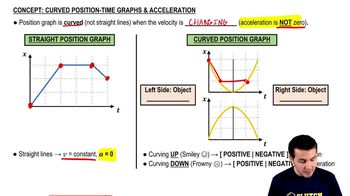
A position vs. time graph visually represents the relationship between an object's position and the time elapsed. For the speeder, the graph will show a straight line indicating constant velocity, while the police car's graph will be a curve that starts at the origin and rises more steeply as it accelerates. Understanding how to interpret these graphs is essential for analyzing the motion of both vehicles.
Recommended video:
Guided course
03:04
Curved Position-Time Graphs & Acceleration