Ch. 02 - Describing Motion: Kinematics in One Dimension
Giancoli Douglas - Physics for Scientists and Engineers 5th edition
Giancoli Douglas5th editionPhysics for Scientists and EngineersISBN: 9780137488179Not the one you use?Change textbook
Chapter 2, Problem 69

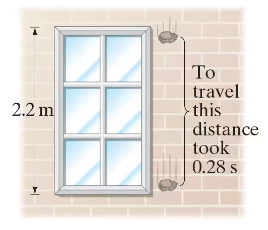
A falling stone takes 0.28 s to travel past a window 2.2 m tall (Fig. 2–49). From what height above the top of the window did the stone fall?
Illustration of a window 2.2 m tall, with a stone falling past it, taking 0.28 seconds to travel the distance.

Verified step by step guidance
1
Identify the known quantities: The time it takes for the stone to pass the window is 0.28 s, and the height of the window is 2.2 m. Assume the stone is in free fall, so the acceleration due to gravity is \( g = 9.8 \; \text{m/s}^2 \).
Determine the velocity of the stone as it passes the top of the window. Use the kinematic equation for constant acceleration: \( h = v_0 t + \frac{1}{2} a t^2 \). Here, \( h = 2.2 \; \text{m} \), \( t = 0.28 \; \text{s} \), and \( a = g = 9.8 \; \text{m/s}^2 \). Solve for the initial velocity \( v_0 \) at the top of the window.
Once \( v_0 \) is determined, use it to calculate the height from which the stone fell above the window. The stone's velocity at the top of the window is related to its initial height by the kinematic equation: \( v_0^2 = v_i^2 + 2 a h \), where \( v_i = 0 \; \text{m/s} \) (since the stone starts from rest), \( a = g \), and \( h \) is the height above the window.
Rearrange the equation \( v_0^2 = 2 g h \) to solve for \( h \): \( h = \frac{v_0^2}{2 g} \). Substitute the value of \( v_0 \) obtained in the previous step and \( g = 9.8 \; \text{m/s}^2 \) to find the height.
Add the height of the window (2.2 m) to the calculated height above the window to determine the total height from which the stone fell.

Verified video answer for a similar problem:

This video solution was recommended by our tutors as helpful for the problem above.
Was this helpful?

Key Concepts

Here are the essential concepts you must grasp in order to answer the question correctly.

Kinematics

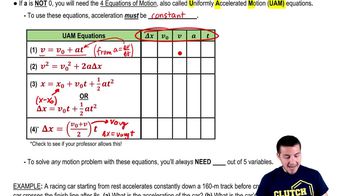
Kinematics is the branch of physics that describes the motion of objects without considering the forces that cause the motion. It involves concepts such as displacement, velocity, acceleration, and time. In this problem, kinematic equations will be used to relate the distance the stone falls to the time it takes to pass the window.
Recommended video:
Guided course
08:25
Kinematics Equations

Acceleration due to Gravity

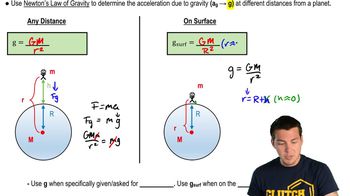
Acceleration due to gravity is the rate at which an object accelerates towards the Earth when in free fall, typically denoted as 'g' and approximately equal to 9.81 m/s². This constant is crucial for calculating the distance fallen by the stone, as it influences how quickly the stone accelerates as it descends.
Recommended video:
Guided course
05:20
Acceleration Due to Gravity

Free Fall

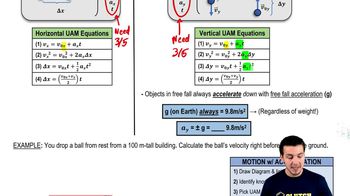
Free fall refers to the motion of an object under the influence of gravity alone, with no other forces acting on it, such as air resistance. In this scenario, the stone is in free fall as it descends past the window, allowing us to apply the equations of motion to determine the height from which it fell.
Recommended video:
Guided course
08:36
Vertical Motion & Free Fall
Related Practice
Textbook Question

A baseball is seen to pass upward by a window with a vertical speed of 13 m/s. If the ball was thrown by a person 18 m below on the street, when was it thrown?

1
views

Textbook Question

A police car at rest is passed by a speeder traveling at a constant 140 km/h. The police officer takes off in hot pursuit and catches up to the speeder in 850 m, maintaining a constant acceleration. Qualitatively plot the position vs. time graph for both cars from the police car's start to the catch-up point.

1
views
Textbook Question

The position of a ball rolling in a straight line is given by 𝓍 = 2.0 ― 3.6t + 1.7t², where 𝓍 is in meters and t in seconds. What do the numbers 2.0, 3.6, and 1.7 refer to?

3
views
Textbook Question

Air resistance acting on a falling body can be taken into account by the approximate relation for the acceleration: a = dv/dt = g ― kv, where k is a constant. Determine an expression for the terminal velocity, which is the maximum value the velocity reaches.

2
views
Textbook Question

Roger sees water balloons fall past his window. He notices that each balloon strikes the sidewalk 0.83 s after passing his window, 15 m above the sidewalk. Assuming the balloons are being released from rest, from what height are they being released?

1
views
Textbook Question

A helicopter is ascending vertically with a constant speed of 6.40 m/s. At a height of 105 m above the Earth, a package is dropped from the helicopter. How much time does it take for the package to reach the ground? [Hint: What is v₀ for the package?]

1
views