Textbook Question
A rocket rises vertically, from rest, with an acceleration of 3.2 m/s² until it runs out of fuel at an altitude of 725 m. After this point, its acceleration is that of gravity, downward. What maximum altitude does the rocket reach?

 Giancoli Douglas 5th editionCh. 02 - Describing Motion: Kinematics in One DimensionProblem 68c
 Verified step by step guidance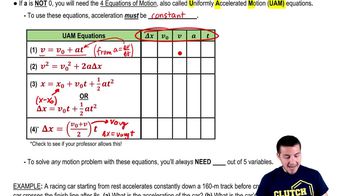
 08:25
08:25
 04:44
04:44 05:20
05:20A rocket rises vertically, from rest, with an acceleration of 3.2 m/s² until it runs out of fuel at an altitude of 725 m. After this point, its acceleration is that of gravity, downward. What maximum altitude does the rocket reach?
The position of a ball rolling in a straight line is given by 𝓍 = 2.0 ― 3.6t + 1.7t², where 𝓍 is in meters and t in seconds. What do the numbers 2.0, 3.6, and 1.7 refer to?
Air resistance acting on a falling body can be taken into account by the approximate relation for the acceleration: a = dv/dt = g ― kv, where k is a constant. Determine an expression for the terminal velocity, which is the maximum value the velocity reaches.
Roger sees water balloons fall past his window. He notices that each balloon strikes the sidewalk 0.83 s after passing his window, 15 m above the sidewalk. Assuming the balloons are being released from rest, from what height are they being released?
A helicopter is ascending vertically with a constant speed of 6.40 m/s. At a height of 105 m above the Earth, a package is dropped from the helicopter. How much time does it take for the package to reach the ground? [Hint: What is v₀ for the package?]
A falling stone takes 0.28 s to travel past a window 2.2 m tall (Fig. 2–49). From what height above the top of the window did the stone fall?