Ch. 02 - Describing Motion: Kinematics in One Dimension
Giancoli Douglas - Physics for Scientists and Engineers 5th edition
Giancoli Douglas5th editionPhysics for Scientists and EngineersISBN: 9780137488179Not the one you use?Change textbook
Chapter 2, Problem 95a

Suppose a 65-kg person jumps from a height of 3.0 m down to the ground. What is the speed of the person just before landing (Chapter 2)?
<IMAGE>

Verified step by step guidance
1
Identify the type of motion involved: This is a free-fall motion problem where the person is acted upon only by gravity. The initial velocity (v₀) is 0 m/s since the person starts from rest, and the acceleration is due to gravity (g = 9.8 m/s²).
Use the kinematic equation to relate the initial velocity, final velocity, acceleration, and displacement: \( v^2 = v_0^2 + 2g h \), where \( v \) is the final velocity, \( v_0 \) is the initial velocity, \( g \) is the acceleration due to gravity, and \( h \) is the height.
Substitute the known values into the equation: \( v_0 = 0 \), \( g = 9.8 \ \text{m/s}^2 \), and \( h = 3.0 \ \text{m} \). The equation simplifies to \( v^2 = 2(9.8)(3.0) \).
Solve for \( v \) by taking the square root of both sides: \( v = \sqrt{2(9.8)(3.0)} \).
Interpret the result: The value of \( v \) represents the speed of the person just before landing. Ensure the units are consistent and the result is in meters per second (m/s).

Verified video answer for a similar problem:

This video solution was recommended by our tutors as helpful for the problem above.
Was this helpful?

Key Concepts

Here are the essential concepts you must grasp in order to answer the question correctly.

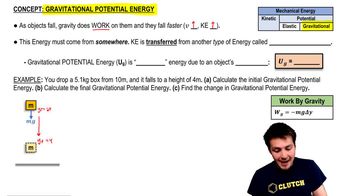
Gravitational Potential Energy

Gravitational potential energy (GPE) is the energy an object possesses due to its position in a gravitational field. It is calculated using the formula GPE = mgh, where m is mass, g is the acceleration due to gravity (approximately 9.81 m/s² on Earth), and h is the height above the ground. In this scenario, the person has potential energy at a height of 3.0 m, which will convert to kinetic energy as they fall.
Recommended video:
Guided course
06:35
Gravitational Potential Energy

Kinetic Energy

Kinetic energy (KE) is the energy of an object in motion, given by the formula KE = 0.5mv², where m is mass and v is velocity. As the person falls, the gravitational potential energy is converted into kinetic energy, increasing their speed until they reach the ground. The speed just before landing can be determined by equating the initial potential energy to the kinetic energy at the moment of impact.
Recommended video:
Guided course
06:07
Intro to Rotational Kinetic Energy

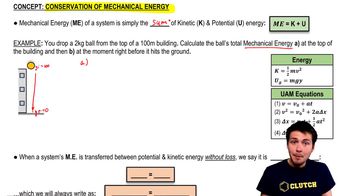
Conservation of Energy

The principle of conservation of energy states that energy cannot be created or destroyed, only transformed from one form to another. In this case, the gravitational potential energy of the person at the height of 3.0 m is transformed into kinetic energy as they fall. By applying this principle, we can calculate the speed of the person just before landing by setting the potential energy equal to the kinetic energy.
Recommended video:
Guided course
06:24
Conservation Of Mechanical Energy
Related Practice
Textbook Question

Bill can throw a ball vertically at a speed 1.5 times faster than Joe can. How many times higher will Bill's ball go than Joe's?

1
views

Textbook Question

A robot used in a pharmacy picks up a medicine bottle at t = 0. It accelerates at 0.20 m/s² for 4.5 s, then travels without acceleration for 68 s and finally decelerates at ―0.40 m/s² for 2.5 s to reach the counter where the pharmacist will take the medicine from the robot. From how far away did the robot fetch the medicine?

1
views
Textbook Question

A police car at rest is passed by a speeder traveling at a constant 140 km/h. The police officer takes off in hot pursuit and catches up to the speeder in 850 m, maintaining a constant acceleration. Qualitatively plot the position vs. time graph for both cars from the police car's start to the catch-up point.

1
views
Textbook Question

The position of a ball rolling in a straight line is given by 𝓍 = 2.0 ― 3.6t + 1.7t², where 𝓍 is in meters and t in seconds. What do the numbers 2.0, 3.6, and 1.7 refer to?

3
views
Textbook Question

Two children are playing on two trampolines. The first child bounces up one-and-a-half times higher than the second child. The initial speed upwards of the second child is 4.0 m/s. What is the initial speed of the first child?

1
views
Textbook Question

A parachutist bails out of an airplane, and freely falls 75 m (ignore air friction). Then the parachute opens, and her acceleration is ― 1.5 m/s² (up). The parachutist reaches the ground with a speed of 1.5 m/s. From how high did she bail out of the plane?

1
views