Ch 07: Newton's Third Law
Knight Calc - Physics for Scientists and Engineers 5th Edition
Knight Calc5th EditionPhysics for Scientists and EngineersISBN: 9780137344796Not the one you use?Change textbook
Chapter 7, Problem 47

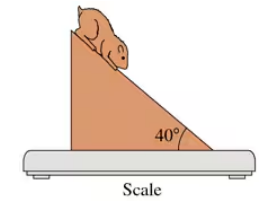
FIGURE P7.47 shows a 200 g hamster sitting on an 800 g wedge-shaped block. The block, in turn, rests on a spring scale. An extra-fine lubricating oil having μs = μk = 0 is sprayed on the top surface of the block, causing the hamster to slide down. Friction between the block and the scale is large enough that the block does not slip on the scale. What does the scale read, in grams, as the hamster slides down?

Verified step by step guidance
1
Understand the problem: The hamster slides down a frictionless wedge-shaped block, which rests on a spring scale. The goal is to determine the reading of the scale in grams as the hamster slides down. Note that the block does not slip on the scale, and the lubricating oil ensures no friction between the hamster and the block.
Analyze the forces: The spring scale measures the total normal force exerted by the block and the hamster on it. This force is equal to the combined gravitational forces of the block and the hamster, as there is no vertical acceleration of the system.
Express the gravitational forces: The gravitational force acting on the hamster is given by \( F_{\text{hamster}} = m_{\text{hamster}} g \), where \( m_{\text{hamster}} = 0.2 \, \text{kg} \) and \( g = 9.8 \, \text{m/s}^2 \). Similarly, the gravitational force acting on the block is \( F_{\text{block}} = m_{\text{block}} g \), where \( m_{\text{block}} = 0.8 \, \text{kg} \).
Combine the forces: Since the block does not slip on the scale and the hamster's motion is along the inclined surface, the vertical forces add directly. The total force measured by the scale is \( F_{\text{total}} = F_{\text{hamster}} + F_{\text{block}} = (m_{\text{hamster}} + m_{\text{block}}) g \).
Convert to grams: The scale reading is typically given in grams. To convert the total force to grams, use the relationship \( 1 \; \text{kg} = 1000 \; \text{g} \). Thus, the scale reading is \( (m_{\text{hamster}} + m_{\text{block}}) \times 1000 \; \text{g} \).

Verified video answer for a similar problem:

This video solution was recommended by our tutors as helpful for the problem above.
Video duration:
10m
Was this helpful?

Key Concepts

Here are the essential concepts you must grasp in order to answer the question correctly.

Friction

Friction is the force that opposes the relative motion of two surfaces in contact. In this scenario, the hamster is sliding down the wedge-shaped block due to the absence of friction (μₛ = μₖ = 0) between them. Understanding friction is crucial as it determines whether an object will remain stationary or move when a force is applied.
Recommended video:
Guided course
08:11
Static Friction & Equilibrium

Newton's Second Law

Newton's Second Law states that the acceleration of an object is directly proportional to the net force acting on it and inversely proportional to its mass (F = ma). This principle is essential for analyzing the forces acting on the hamster and the wedge, allowing us to calculate the resultant forces and the reading on the spring scale as the hamster slides down.
Recommended video:
Guided course
06:54
Intro to Forces & Newton's Second Law

Weight and Normal Force

Weight is the force exerted by gravity on an object, calculated as the product of mass and gravitational acceleration (W = mg). The normal force is the support force exerted by a surface perpendicular to the object. In this problem, the weight of the hamster and the wedge affects the reading on the scale, as the normal force changes when the hamster slides down the block.
Recommended video:
Guided course
08:17
The Normal Force