Ch 12: Rotation of a Rigid Body
Knight Calc - Physics for Scientists and Engineers 5th Edition
Knight Calc5th EditionPhysics for Scientists and EngineersISBN: 9780137344796Not the one you use?Change textbook
Chapter 12, Problem 13a

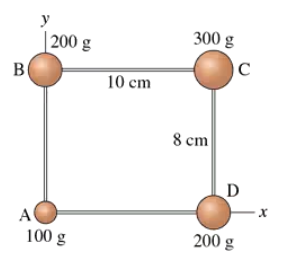
The four masses shown in FIGURE EX12.13 are connected by massless, rigid rods. Find the coordinates of the center of mass.

Verified step by step guidance
1
Step 1: Understand the problem. The center of mass (COM) is the weighted average position of all the masses in the system. To find the coordinates of the center of mass, we use the formulas: \( x_{COM} = \frac{\sum m_i x_i}{\sum m_i} \) and \( y_{COM} = \frac{\sum m_i y_i}{\sum m_i} \), where \( m_i \) is the mass of each object, and \( x_i \) and \( y_i \) are the coordinates of each mass.
Step 2: Extract the data from the image. The masses and their coordinates are: \( m_A = 70 \, \text{g}, (x_A, y_A) = (0, 0) \), \( m_B = 190 \, \text{g}, (x_B, y_B) = (20, 0) \), and \( m_C = 400 \, \text{g}, (x_C, y_C) = (20, 12) \).
Step 3: Calculate the total mass \( \sum m_i \). Add the masses: \( \sum m_i = m_A + m_B + m_C \).
Step 4: Compute \( x_{COM} \). Use the formula \( x_{COM} = \frac{m_A x_A + m_B x_B + m_C x_C}{\sum m_i} \). Substitute the values of \( m_i \) and \( x_i \) from the data.
Step 5: Compute \( y_{COM} \). Use the formula \( y_{COM} = \frac{m_A y_A + m_B y_B + m_C y_C}{\sum m_i} \). Substitute the values of \( m_i \) and \( y_i \) from the data.

Verified video answer for a similar problem:

This video solution was recommended by our tutors as helpful for the problem above.
Video duration:
9m
Was this helpful?

Key Concepts

Here are the essential concepts you must grasp in order to answer the question correctly.

Center of Mass

The center of mass of a system is the point where the total mass of the system can be considered to be concentrated. It is calculated as the weighted average of the positions of all masses in the system, taking into account their respective masses. The formula for the center of mass in two dimensions is given by the coordinates (x_cm, y_cm) = (Σ(m_i * x_i) / Σm_i, Σ(m_i * y_i) / Σm_i), where m_i is the mass and (x_i, y_i) are the coordinates of each mass.
Recommended video:
Guided course
06:30
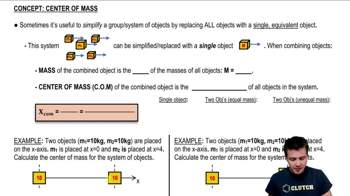
Intro to Center of Mass

Mass Distribution

Mass distribution refers to how mass is spread out in a system. In this problem, the masses A, B, and C are located at specific coordinates, and their distribution affects the calculation of the center of mass. Understanding how different masses contribute to the overall center of mass is crucial, as heavier masses will have a greater influence on the position of the center of mass compared to lighter ones.
Recommended video:
Guided course
03:42
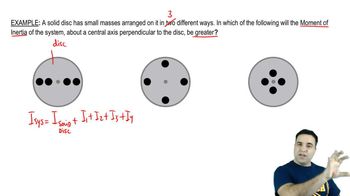
Moment of Inertia & Mass Distribution

Coordinate System

A coordinate system provides a framework for locating points in space using numerical values. In this problem, a Cartesian coordinate system is used, where each point is defined by its x (horizontal) and y (vertical) coordinates. This system is essential for calculating the center of mass, as it allows for precise determination of the positions of the masses involved in the calculation.
Recommended video:
Guided course
05:17
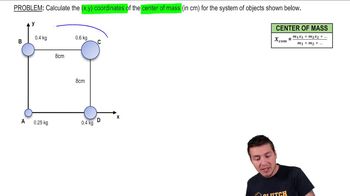
Coordinates of Center of Mass of 4 objects