Ch 12: Rotation of a Rigid Body
Knight Calc - Physics for Scientists and Engineers 5th Edition
Knight Calc5th EditionPhysics for Scientists and EngineersISBN: 9780137344796Not the one you use?Change textbook
Chapter 12, Problem 14b

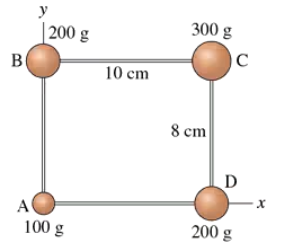
The four masses shown in FIGURE EX12.13 are connected by massless, rigid rods. Find the moment of inertia about a diagonal axis that passes through masses B and D.

Verified step by step guidance
1
Step 1: Understand the concept of moment of inertia. The moment of inertia (I) is a measure of an object's resistance to rotational motion about a given axis. It is calculated using the formula: I=inmiri^2, where mi is the mass of the ith particle and ri is the perpendicular distance of the ith particle from the axis of rotation.
Step 2: Identify the axis of rotation. The problem specifies a diagonal axis passing through masses B and D. This means that masses B and D lie directly on the axis, so their perpendicular distance from the axis is zero. Therefore, their contribution to the moment of inertia is zero.
Step 3: Determine the perpendicular distances of masses A and C from the diagonal axis. To do this, use geometry to calculate the shortest distance from each mass to the diagonal axis. This may involve finding the coordinates of the masses and using the formula for the distance between a point and a line in 2D space.
Step 4: Calculate the contributions to the moment of inertia from masses A and C. For each mass, use the formula I=miri^2, where ri is the perpendicular distance calculated in Step 3.
Step 5: Sum the contributions from masses A and C to find the total moment of inertia about the diagonal axis. Since masses B and D contribute zero, the total moment of inertia is simply the sum of the values calculated for masses A and C.

Verified video answer for a similar problem:

This video solution was recommended by our tutors as helpful for the problem above.
Video duration:
9m
Was this helpful?

Key Concepts

Here are the essential concepts you must grasp in order to answer the question correctly.

Moment of Inertia

The moment of inertia is a measure of an object's resistance to rotational motion about a specific axis. It depends on the mass distribution relative to the axis of rotation, calculated as the sum of the products of each mass and the square of its distance from the axis. For a system of particles, it is expressed as I = Σ(m_i * r_i^2), where m_i is the mass and r_i is the distance from the axis.
Recommended video:
Guided course
11:47
Intro to Moment of Inertia

Parallel Axis Theorem

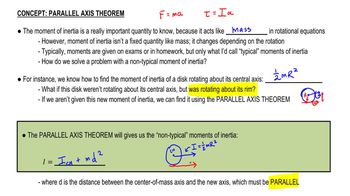
The parallel axis theorem allows the calculation of the moment of inertia of a body about any axis parallel to an axis through its center of mass. It states that I = I_cm + Md^2, where I_cm is the moment of inertia about the center of mass axis, M is the total mass, and d is the distance between the two axes. This theorem is useful when the axis of rotation does not pass through the center of mass.
Recommended video:
Guided course
13:46
Parallel Axis Theorem

Rigid Body Dynamics

Rigid body dynamics studies the motion of solid objects that do not deform under stress. In this context, the masses connected by massless rods behave as a rigid body, allowing the application of rotational motion principles. Understanding how forces and torques affect the motion of such systems is crucial for analyzing their behavior, particularly when calculating moments of inertia about various axes.
Recommended video:
Guided course
08:42
Free-Body Diagrams