A thin, 100 g disk with a diameter of 8.0 cm rotates about an axis through its center with 0.15 J of kinetic energy. What is the speed of a point on the rim?
Ch 12: Rotation of a Rigid Body
Knight Calc5th EditionPhysics for Scientists and EngineersISBN: 9780137344796Not the one you use?Change textbook
Chapter 12, Problem 11b
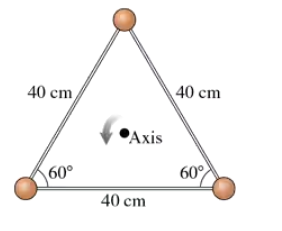
The three 200 g masses in FIGURE EX12.11 are connected by massless, rigid rods. What is the triangle's kinetic energy if it rotates about the axis at 5.0 rev/s?

Verified step by step guidance1
Step 1: Identify the given values from the problem. The masses of the three objects are 200 g each, which can be converted to kilograms (0.2 kg). The radius of rotation is given as 45 cm, which can be converted to meters (0.45 m). The rotational speed is 5.0 revolutions per second.
Step 2: Calculate the moment of inertia (I) for the system. Since the masses are connected by massless rods and are equidistant from the axis of rotation, the moment of inertia for each mass is given by \( I = m r^2 \). For three masses, the total moment of inertia is \( I_{total} = 3 m r^2 \). Substitute the values of mass (m = 0.2 kg) and radius (r = 0.45 m) into the formula.
Step 3: Convert the rotational speed from revolutions per second to angular velocity in radians per second. Use the formula \( \omega = 2 \pi f \), where \( f \) is the frequency in revolutions per second. Substitute \( f = 5.0 \) into the formula to find \( \omega \).
Step 4: Use the formula for rotational kinetic energy \( KE = \frac{1}{2} I \omega^2 \). Substitute the values of \( I \) (calculated in Step 2) and \( \omega \) (calculated in Step 3) into the formula.
Step 5: Simplify the expression to find the kinetic energy. Ensure all units are consistent (mass in kg, radius in meters, angular velocity in radians per second) before performing the calculation.

Verified video answer for a similar problem:
This video solution was recommended by our tutors as helpful for the problem above.
Video duration:
6mWas this helpful?
Key Concepts
Here are the essential concepts you must grasp in order to answer the question correctly.
Kinetic Energy of Rotation
The kinetic energy of a rotating object is given by the formula KE = 1/2 I ω², where I is the moment of inertia and ω is the angular velocity in radians per second. This concept is crucial for understanding how the mass distribution and rotation speed affect the energy of the system.
Recommended video:
Guided course
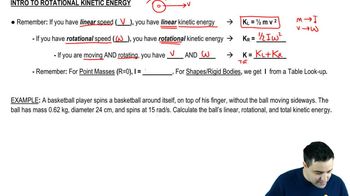
Intro to Rotational Kinetic Energy
Moment of Inertia
The moment of inertia (I) quantifies how mass is distributed relative to the axis of rotation. For point masses, it is calculated as I = Σ mᵢ rᵢ², where mᵢ is the mass and rᵢ is the distance from the axis. In this case, the three 200 g masses contribute to the total moment of inertia based on their distances from the rotation axis.
Recommended video:
Guided course
Intro to Moment of Inertia
Angular Velocity
Angular velocity (ω) measures how fast an object rotates and is expressed in radians per second. To convert revolutions per second to radians per second, multiply by 2π (ω = rev/s × 2π). This is essential for calculating the kinetic energy of the rotating triangle in the given problem.
Recommended video:
Guided course
Intro to Angular Momentum
Related Practice
Textbook Question
2
views
Textbook Question
The four masses shown in FIGURE EX12.13 are connected by massless, rigid rods. Find the coordinates of the center of mass.
3
views
Textbook Question
What is the rotational kinetic energy of the earth? Assume the earth is a uniform sphere. Data for the earth can be found inside the back cover of the book.
1
views
Textbook Question
The three masses shown in FIGURE EX12.15 are connected by massless, rigid rods. Find the coordinates of the center of mass.
2
views
Textbook Question
The four masses shown in FIGURE EX12.13 are connected by massless, rigid rods. Find the moment of inertia about a diagonal axis that passes through masses B and D.
3
views
Textbook Question
Two balls are connected by a 150-cm-long massless rod. The center of mass is 35 cm from a 75 g ball on one end. What is the mass attached to the other end?
2
views