A 25 kg solid door is 220 cm tall, 91 cm wide. What is the door's moment of inertia for rotation on its hinges?
Ch 12: Rotation of a Rigid Body
Knight Calc5th EditionPhysics for Scientists and EngineersISBN: 9780137344796Not the one you use?Change textbook
Chapter 12, Problem 15b
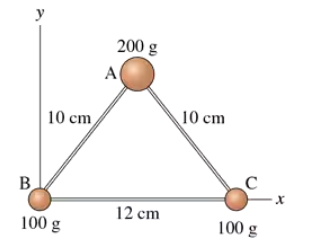
The three masses shown in FIGURE EX12.15 are connected by massless, rigid rods. Find the moment of inertia about an axis that passes through mass A and is perpendicular to the page.

Verified step by step guidance1
Step 1: Recall the formula for the moment of inertia about a given axis: \( I = \sum m_i r_i^2 \), where \( m_i \) is the mass of each object and \( r_i \) is the perpendicular distance of the mass from the axis of rotation.
Step 2: Identify the axis of rotation. In this case, the axis passes through mass A (mass 1, \( 0.35 \, \text{kg} \)) and is perpendicular to the page. Therefore, the distance \( r \) for mass 1 is \( 0 \, \text{m} \) since it lies on the axis.
Step 3: Determine the distances of the other masses (mass 2 and mass 3) from the axis. For mass 2 (\( 0.35 \, \text{kg} \)), the distance is \( 0.30 \, \text{m} \). For mass 3 (\( 0.52 \, \text{kg} \)), the distance is \( 0.25 \, \text{m} \).
Step 4: Substitute the values into the formula for the moment of inertia. For mass 1, \( m_1 r_1^2 = 0.35 \times 0^2 \). For mass 2, \( m_2 r_2^2 = 0.35 \times (0.30)^2 \). For mass 3, \( m_3 r_3^2 = 0.52 \times (0.25)^2 \).
Step 5: Add the contributions from all masses to find the total moment of inertia: \( I = m_1 r_1^2 + m_2 r_2^2 + m_3 r_3^2 \). Simplify the expression to get the final result.

Verified video answer for a similar problem:
This video solution was recommended by our tutors as helpful for the problem above.
Video duration:
5mWas this helpful?
Key Concepts
Here are the essential concepts you must grasp in order to answer the question correctly.
Moment of Inertia
The moment of inertia is a measure of an object's resistance to rotational motion about a specific axis. It depends on the mass distribution relative to that axis, calculated as the sum of the products of each mass and the square of its distance from the axis. For point masses, the formula is I = Σ(m_i * r_i^2), where m_i is the mass and r_i is the distance from the axis.
Recommended video:
Guided course
Intro to Moment of Inertia
Axis of Rotation
The axis of rotation is an imaginary line around which an object rotates. In this problem, the axis passes through mass A and is perpendicular to the page, meaning that the moment of inertia must account for the distances of the other masses from this axis. Understanding the position of the axis is crucial for correctly calculating the moment of inertia.
Recommended video:
Guided course
Parallel Axis Theorem
Mass Distribution
Mass distribution refers to how mass is spread out in an object or system. In this case, the three masses are connected by rigid rods, and their positions relative to the axis of rotation affect the overall moment of inertia. Analyzing the distances and weights of each mass helps in determining how they contribute to the system's resistance to rotation.
Recommended video:
Guided course
Moment of Inertia & Mass Distribution
Related Practice
Textbook Question
2
views
Textbook Question
A 25 kg solid door is 220 cm tall, 91 cm wide. What is the door’s moment of inertia for rotation about a vertical axis inside the door, 15 cm from one edge?
2
views
Textbook Question
The four masses shown in FIGURE EX12.13 are connected by massless, rigid rods. Find the coordinates of the center of mass.
3
views
Textbook Question
A 12-cm-diameter DVD has a mass of 21 g. What is the DVD’s moment of inertia for rotation about a perpendicular axis through its center?
1
views
Textbook Question
The three masses shown in FIGURE EX12.15 are connected by massless, rigid rods. Find the coordinates of the center of mass.
2
views
Textbook Question
The four masses shown in FIGURE EX12.13 are connected by massless, rigid rods. Find the moment of inertia about a diagonal axis that passes through masses B and D.
3
views