

Ch 12: Rotation of a Rigid Body
Knight Calc - Physics for Scientists and Engineers 5th Edition
Knight Calc5th EditionPhysics for Scientists and EngineersISBN: 9780137344796Not the one you use?Change textbook
Chapter 12, Problem 61

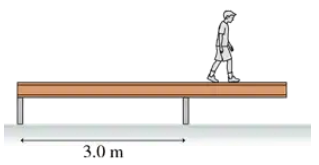
A 40 kg, 5.0-m-long beam is supported by, but not attached to, the two posts in FIGURE P12.61. A 20 kg boy starts walking along the beam. How close can he get to the right end of the beam without it falling over?

Verified step by step guidance
1
Step 1: Identify the forces acting on the beam. The beam is supported by two posts, and the forces include the weight of the beam (40 kg), the weight of the boy (20 kg), and the reaction forces at the two posts. The beam's weight acts at its center of gravity, which is at the midpoint of the beam (2.5 m from either end).
Step 2: Define the pivot point for torque calculations. To determine when the beam will tip, choose the right post as the pivot point. The beam will tip when the torque due to the boy's weight exceeds the counteracting torque due to the beam's weight and the reaction force at the left post.
Step 3: Write the torque equation about the pivot point. The torque due to the boy's weight is \( \tau_{boy} = m_{boy} \cdot g \cdot d_{boy} \), where \( m_{boy} \) is the boy's mass, \( g \) is the acceleration due to gravity, and \( d_{boy} \) is the distance of the boy from the pivot point. The torque due to the beam's weight is \( \tau_{beam} = m_{beam} \cdot g \cdot d_{beam} \), where \( m_{beam} \) is the beam's mass and \( d_{beam} \) is the distance of the beam's center of gravity from the pivot point.
Step 4: Solve for the maximum distance \( d_{boy} \). Set the sum of the clockwise torques equal to the sum of the counterclockwise torques to find the maximum distance the boy can walk before the beam tips. Use the equation \( m_{boy} \cdot g \cdot d_{boy} = m_{beam} \cdot g \cdot d_{beam} \). Cancel \( g \) from both sides and solve for \( d_{boy} \).
Step 5: Substitute the known values into the equation. The beam's mass is 40 kg, its center of gravity is 2.5 m from the pivot point, and the boy's mass is 20 kg. Solve for \( d_{boy} \) to determine how close the boy can get to the right end of the beam without it tipping.

Verified video answer for a similar problem:

This video solution was recommended by our tutors as helpful for the problem above.
Was this helpful?

Key Concepts

Here are the essential concepts you must grasp in order to answer the question correctly.

Torque

Torque is a measure of the rotational force applied to an object, calculated as the product of the force and the distance from the pivot point (lever arm). In this scenario, the beam will rotate about the point where it is supported by the posts. Understanding how the boy's position affects the torque on the beam is crucial for determining how close he can walk to the edge without causing it to tip over.
Recommended video:
Guided course
08:55
Net Torque & Sign of Torque

Center of Mass

The center of mass is the point at which the mass of an object is concentrated and can be considered to act. For the beam and the boy, the center of mass will shift as the boy walks along the beam. Knowing the position of the center of mass helps in analyzing the stability of the beam and predicting when it will tip over as the boy approaches the edge.
Recommended video:
Guided course
06:30
Intro to Center of Mass

Equilibrium

Equilibrium occurs when the sum of forces and the sum of torques acting on an object are both zero, resulting in a stable condition. In this problem, the beam is in static equilibrium when the torques due to the weights of the beam and the boy balance out. Understanding the conditions for equilibrium is essential to determine the maximum distance the boy can walk without causing the beam to fall.
Recommended video:
Guided course
10:13
Torque & Equilibrium
Related Practice
Textbook Question

Blocks of mass m₁ and m₂ are connected by a massless string that passes over the pulley in FIGURE P12.64. The pulley turns on frictionless bearings. Mass m₁ slides on a horizontal, frictionless surface. Mass m₂ is released while the blocks are at rest. Assume the pulley is massless. Find the acceleration of m₁ and the tension in the string. This is a Chapter 7 review problem.

1
views
Textbook Question

A person's center of mass is easily found by having the person lie on a reaction board. A horizontal, 2.5-m-long, 6.1 kg reaction board is supported only at the ends, with one end resting on a scale and the other on a pivot. A 60 kg woman lies on the reaction board with her feet over the pivot. The scale reads 25 kg. What is the distance from the woman's feet to her center of mass?

2
views
Textbook Question

Your task in a science contest is to stack four identical uniform bricks, each of length L, so that the top brick is as far to the right as possible without the stack falling over. Is it possible, as FIGURE P12.60 shows, to stack the bricks such that no part of the top brick is over the table? Answer this question by determining the maximum possible value of d.

2
views
Textbook Question

Blocks of mass m1 and m2 are connected by a massless string that passes over the pulley in FIGURE P12.64. The pulley turns on frictionless bearings. Mass m1 slides on a horizontal, frictionless surface. Mass m2 is released while the blocks are at rest. Suppose the pulley has mass mp and radius R. Find the acceleration of m1 and the tensions in the upper and lower portions of the string. Verify that your answers agree with part a if you set mp = 0.

1
views
Textbook Question

A 3.0-m-long ladder, as shown in Figure 12.35, leans against a frictionless wall. The coefficient of static friction between the ladder and the floor is 0.40. What is the minimum angle the ladder can make with the floor without slipping?

Textbook Question

FIGURE P12.63 shows a 15 kg cylinder held at rest on a 20° slope. What is the magnitude of the static friction force?

2
views