
Textbook Question
A 40 kg, 5.0-m-long beam is supported by, but not attached to, the two posts in FIGURE P12.61. A 20 kg boy starts walking along the beam. How close can he get to the right end of the beam without it falling over?
1
views

 Verified step by step guidance
 06:54
06:54
 04:39
04:39 08:42
08:42A 40 kg, 5.0-m-long beam is supported by, but not attached to, the two posts in FIGURE P12.61. A 20 kg boy starts walking along the beam. How close can he get to the right end of the beam without it falling over?
Your task in a science contest is to stack four identical uniform bricks, each of length L, so that the top brick is as far to the right as possible without the stack falling over. Is it possible, as FIGURE P12.60 shows, to stack the bricks such that no part of the top brick is over the table? Answer this question by determining the maximum possible value of d.
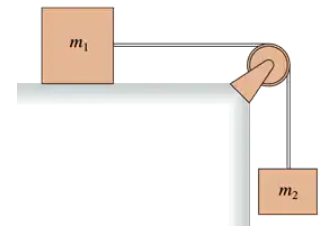
Blocks of mass m1 and m2 are connected by a massless string that passes over the pulley in FIGURE P12.64. The pulley turns on frictionless bearings. Mass m1 slides on a horizontal, frictionless surface. Mass m2 is released while the blocks are at rest. Suppose the pulley has mass mp and radius R. Find the acceleration of m1 and the tensions in the upper and lower portions of the string. Verify that your answers agree with part a if you set mp = 0.
The 2.0 kg, 30-cm-diameter disk in FIGURE P12.65 is spinning at 300 rpm. How much friction force must the brake apply to the rim to bring the disk to a halt in 3.0 s?
FIGURE P12.63 shows a 15 kg cylinder held at rest on a 20° slope. What is the magnitude of the static friction force?
Flywheels are large, massive wheels used to store energy. They can be spun up slowly, then the wheel's energy can be released quickly to accomplish a task that demands high power. An industrial flywheel has a 1.5 m diameter and a mass of 250 kg. Its maximum angular velocity is 1200 rpm. How much energy is stored in the flywheel?