Ch 12: Rotation of a Rigid Body
Knight Calc - Physics for Scientists and Engineers 5th Edition
Knight Calc5th EditionPhysics for Scientists and EngineersISBN: 9780137344796Not the one you use?Change textbook
Chapter 12, Problem 64b

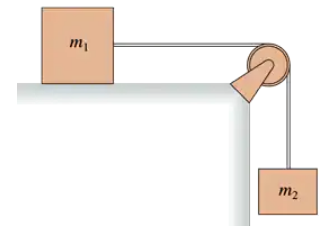
Blocks of mass m1 and m2 are connected by a massless string that passes over the pulley in FIGURE P12.64. The pulley turns on frictionless bearings. Mass m1 slides on a horizontal, frictionless surface. Mass m2 is released while the blocks are at rest. Suppose the pulley has mass mp and radius R. Find the acceleration of m1 and the tensions in the upper and lower portions of the string. Verify that your answers agree with part a if you set mp = 0.

Verified step by step guidance
1
Step 1: Begin by analyzing the forces acting on each block and the pulley. For block m1, the tension T1 in the string is the only horizontal force acting on it. For block m2, the forces are the tension T2 in the string acting upward and the gravitational force m2 * g acting downward. For the pulley, the tensions T1 and T2 create a torque due to the radius R.
Step 2: Write Newton's second law for each block. For m1, the equation is m1 * a = T1, where a is the acceleration of the block. For m2, the equation is m2 * g - T2 = m2 * a, where a is the acceleration of the block downward.
Step 3: Write the rotational dynamics equation for the pulley. The net torque on the pulley is (T2 - T1) * R, and this torque is equal to the moment of inertia of the pulley (I = 0.5 * mp * R^2 for a solid disk) multiplied by its angular acceleration α. Since the linear acceleration a of the blocks is related to the angular acceleration of the pulley by a = α * R, the equation becomes (T2 - T1) * R = 0.5 * mp * R^2 * (a / R).
Step 4: Combine the equations from steps 2 and 3 to solve for the acceleration a. Substitute the expressions for T1 and T2 into the rotational dynamics equation and solve for a in terms of m1, m2, mp, R, and g.
Step 5: Once the acceleration a is determined, use the equations from step 2 to solve for the tensions T1 and T2 in the string. Verify that the results agree with the case where mp = 0 by substituting mp = 0 into the equations and checking that the acceleration and tensions simplify appropriately.

Verified video answer for a similar problem:

This video solution was recommended by our tutors as helpful for the problem above.
Was this helpful?

Key Concepts

Here are the essential concepts you must grasp in order to answer the question correctly.

Newton's Second Law

Newton's Second Law states that the acceleration of an object is directly proportional to the net force acting on it and inversely proportional to its mass. This principle is fundamental in analyzing the motion of the blocks in the system, as it allows us to relate the forces acting on each mass to their respective accelerations.
Recommended video:
Guided course
06:54
Intro to Forces & Newton's Second Law

Tension in a String

Tension is the force transmitted through a string or rope when it is pulled tight by forces acting at either end. In this problem, the tension in the string affects the acceleration of both masses and must be calculated for both segments of the string, considering the mass of the pulley and the gravitational force acting on m2.
Recommended video:
Guided course
04:39
Energy & Power of Waves on Strings

Pulley Dynamics

In this scenario, the pulley is not massless, which means its rotational inertia must be considered. The dynamics of the pulley involve analyzing how the tension in the string creates torque, affecting its angular acceleration. This adds complexity to the problem, as the relationship between linear acceleration of the masses and angular acceleration of the pulley must be established.
Recommended video:
Guided course
08:28
Torque on Discs & Pulleys
Related Practice
Textbook Question

A 40 kg, 5.0-m-long beam is supported by, but not attached to, the two posts in FIGURE P12.61. A 20 kg boy starts walking along the beam. How close can he get to the right end of the beam without it falling over?

1
views

Textbook Question

Blocks of mass m₁ and m₂ are connected by a massless string that passes over the pulley in FIGURE P12.64. The pulley turns on frictionless bearings. Mass m₁ slides on a horizontal, frictionless surface. Mass m₂ is released while the blocks are at rest. Assume the pulley is massless. Find the acceleration of m₁ and the tension in the string. This is a Chapter 7 review problem.

1
views
Textbook Question

A 30-cm-diameter, 1.2 kg solid turntable rotates on a 1.2-cm-diameter, 450 g shaft at a constant 33 rpm. When you hit the stop switch, a brake pad presses against the shaft and brings the turntable to a halt in 15 seconds. How much friction force does the brake pad apply to the shaft?

10
views
Textbook Question

The 2.0 kg, 30-cm-diameter disk in FIGURE P12.65 is spinning at 300 rpm. How much friction force must the brake apply to the rim to bring the disk to a halt in 3.0 s?

Textbook Question

FIGURE P12.63 shows a 15 kg cylinder held at rest on a 20° slope. What is the magnitude of the static friction force?

2
views
Textbook Question

Flywheels are large, massive wheels used to store energy. They can be spun up slowly, then the wheel's energy can be released quickly to accomplish a task that demands high power. An industrial flywheel has a 1.5 m diameter and a mass of 250 kg. Its maximum angular velocity is 1200 rpm. How much energy is stored in the flywheel?

1
views