
Ch 12: Rotation of a Rigid Body
Knight Calc - Physics for Scientists and Engineers 5th Edition
Knight Calc5th EditionPhysics for Scientists and EngineersISBN: 9780137344796Not the one you use?Change textbook
Chapter 12, Problem 65

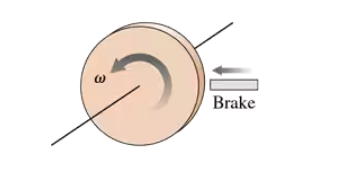
The 2.0 kg, 30-cm-diameter disk in FIGURE P12.65 is spinning at 300 rpm. How much friction force must the brake apply to the rim to bring the disk to a halt in 3.0 s?

Verified step by step guidance
1
Determine the initial angular velocity of the disk in radians per second. Convert the given angular velocity from revolutions per minute (300 rpm) to radians per second using the formula: \( \omega = \frac{2\pi \times \text{rpm}}{60} \).
Calculate the angular deceleration required to bring the disk to a halt in 3.0 seconds. Use the kinematic equation for angular motion: \( \alpha = \frac{\Delta \omega}{\Delta t} \), where \( \Delta \omega \) is the change in angular velocity and \( \Delta t \) is the time interval.
Determine the moment of inertia of the disk. For a solid disk, the moment of inertia is given by \( I = \frac{1}{2} m r^2 \), where \( m \) is the mass of the disk and \( r \) is its radius (half the diameter).
Calculate the torque required to produce the angular deceleration. Use the relationship \( \tau = I \alpha \), where \( \tau \) is the torque, \( I \) is the moment of inertia, and \( \alpha \) is the angular deceleration.
Relate the torque to the friction force applied at the rim. The torque is given by \( \tau = F_r r \), where \( F_r \) is the friction force and \( r \) is the radius of the disk. Solve for \( F_r \) to find the required friction force.

Verified video answer for a similar problem:

This video solution was recommended by our tutors as helpful for the problem above.
Video duration:
10m
Was this helpful?

Key Concepts

Here are the essential concepts you must grasp in order to answer the question correctly.

Angular Velocity

Angular velocity is a measure of how quickly an object rotates around an axis, typically expressed in radians per second. In this problem, the disk's initial angular velocity can be calculated from its given speed of 300 revolutions per minute (rpm), which must be converted to radians per second to analyze the motion effectively.
Recommended video:
Guided course
06:18
Intro to Angular Momentum

Moment of Inertia

The moment of inertia is a property of a body that quantifies its resistance to angular acceleration about an axis. For a solid disk, it is calculated using the formula I = 0.5 * m * r^2, where m is the mass and r is the radius. This concept is crucial for determining how much torque is needed to stop the disk.
Recommended video:
Guided course
11:47
Intro to Moment of Inertia

Torque and Friction Force

Torque is the rotational equivalent of linear force and is calculated as the product of the force applied and the distance from the axis of rotation. In this scenario, the friction force applied at the rim of the disk generates torque that opposes the disk's rotation, and understanding this relationship is essential to calculate the required friction force to bring the disk to a halt within the specified time.
Recommended video:
Guided course
12:54
Force and Torque on Current Loops
Related Practice
Textbook Question

Blocks of mass m₁ and m₂ are connected by a massless string that passes over the pulley in FIGURE P12.64. The pulley turns on frictionless bearings. Mass m₁ slides on a horizontal, frictionless surface. Mass m₂ is released while the blocks are at rest. Assume the pulley is massless. Find the acceleration of m₁ and the tension in the string. This is a Chapter 7 review problem.

1
views
Textbook Question

Blocks of mass m1 and m2 are connected by a massless string that passes over the pulley in FIGURE P12.64. The pulley turns on frictionless bearings. Mass m1 slides on a horizontal, frictionless surface. Mass m2 is released while the blocks are at rest. Suppose the pulley has mass mp and radius R. Find the acceleration of m1 and the tensions in the upper and lower portions of the string. Verify that your answers agree with part a if you set mp = 0.

1
views
Textbook Question

A 30-cm-diameter, 1.2 kg solid turntable rotates on a 1.2-cm-diameter, 450 g shaft at a constant 33 rpm. When you hit the stop switch, a brake pad presses against the shaft and brings the turntable to a halt in 15 seconds. How much friction force does the brake pad apply to the shaft?

10
views
Textbook Question

Your engineering team has been assigned the task of measuring the properties of a new jet-engine turbine. You've previously determined that the turbine's moment of inertia is 2.6 kg m2. The next job is to measure the frictional torque of the bearings. Your plan is to run the turbine up to a predetermined rotation speed, cut the power, and time how long it takes the turbine to reduce its rotation speed by 50%. Your data are given in the table. Draw an appropriate graph of the data and, from the slope of the best-fit line, determine the frictional torque.

1
views
Textbook Question

FIGURE P12.63 shows a 15 kg cylinder held at rest on a 20° slope. What is the magnitude of the static friction force?

2
views
Textbook Question

Flywheels are large, massive wheels used to store energy. They can be spun up slowly, then the wheel's energy can be released quickly to accomplish a task that demands high power. An industrial flywheel has a 1.5 m diameter and a mass of 250 kg. Its maximum angular velocity is 1200 rpm. How much energy is stored in the flywheel?

1
views