Ch 12: Rotation of a Rigid Body
Knight Calc - Physics for Scientists and Engineers 5th Edition
Knight Calc5th EditionPhysics for Scientists and EngineersISBN: 9780137344796Not the one you use?Change textbook
Chapter 12, Problem 58

A person's center of mass is easily found by having the person lie on a reaction board. A horizontal, 2.5-m-long, 6.1 kg reaction board is supported only at the ends, with one end resting on a scale and the other on a pivot. A 60 kg woman lies on the reaction board with her feet over the pivot. The scale reads 25 kg. What is the distance from the woman's feet to her center of mass?

Verified step by step guidance
1
Step 1: Begin by identifying the forces acting on the system. The reaction board is supported at two points: the pivot and the scale. The scale measures the force exerted at one end, which is given as 25 kg (convert this to Newtons by multiplying by gravitational acceleration, \( g = 9.8 \, \text{m/s}^2 \)). The pivot provides the other supporting force.
Step 2: Apply the principle of static equilibrium. Since the system is not moving, the sum of all vertical forces must equal zero. Write the equation for the vertical forces: \( F_{pivot} + F_{scale} = F_{woman} + F_{board} \), where \( F_{woman} \) is the weight of the woman and \( F_{board} \) is the weight of the board.
Step 3: Use the condition for rotational equilibrium. The sum of all torques about any point must be zero. Choose the pivot as the point of rotation to simplify calculations (torque due to \( F_{pivot} \) will be zero since its distance from the pivot is zero). Write the torque equation: \( \tau_{scale} = \tau_{woman} + \tau_{board} \). Torque is calculated as \( \tau = F \cdot d \), where \( F \) is the force and \( d \) is the perpendicular distance from the pivot.
Step 4: Substitute known values into the torque equation. The torque due to the scale is \( F_{scale} \cdot 2.5 \, \text{m} \), the torque due to the board is \( F_{board} \cdot 1.25 \, \text{m} \) (since the center of mass of the board is at its midpoint), and the torque due to the woman is \( F_{woman} \cdot d_{woman} \), where \( d_{woman} \) is the distance from the pivot to the woman's center of mass.
Step 5: Solve for \( d_{woman} \). Rearrange the torque equation to isolate \( d_{woman} \): \( d_{woman} = \frac{\tau_{scale} - \tau_{board}}{F_{woman}} \). Substitute the values for \( \tau_{scale} \), \( \tau_{board} \), and \( F_{woman} \) to find the distance from the woman's feet to her center of mass.

Verified video answer for a similar problem:

This video solution was recommended by our tutors as helpful for the problem above.
Video duration:
10m
Was this helpful?

Key Concepts

Here are the essential concepts you must grasp in order to answer the question correctly.

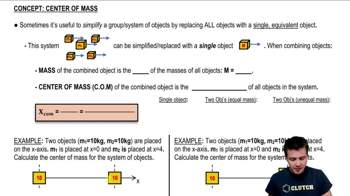
Center of Mass

The center of mass of an object is the point at which its mass is evenly distributed in all directions. For a uniform object, it is located at its geometric center, while for irregular shapes, it can be calculated based on the distribution of mass. In this scenario, understanding the center of mass is crucial for determining how the woman's weight affects the reaction board's balance.
Recommended video:
Guided course
06:30
Intro to Center of Mass

Torque

Torque is a measure of the rotational force applied to an object, calculated as the product of the force and the distance from the pivot point. In this problem, the torque created by the woman's weight about the pivot must be balanced by the torque from the reaction board and the scale reading. Analyzing torque helps in finding the position of the center of mass relative to the pivot.
Recommended video:
Guided course
08:55
Net Torque & Sign of Torque

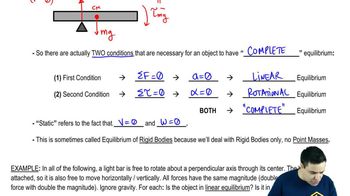
Equilibrium

Equilibrium occurs when all forces and torques acting on an object are balanced, resulting in no net force or rotation. In this case, the reaction board is in static equilibrium, meaning the upward forces from the scale and the pivot must equal the downward forces from the woman and the board's weight. Understanding equilibrium is essential for solving the problem and finding the distance to the woman's center of mass.
Recommended video:
Guided course
10:13
Torque & Equilibrium