
Textbook Question
A small 300 g ball and a small 600 g ball are connected by a 40-cm-long, 200 g rigid rod. b. What is the rotational kinetic energy if the structure rotates about its center of mass at 100 rpm?

 Verified step by step guidance
 11:47
11:47
 13:46
13:46 03:42
03:42A small 300 g ball and a small 600 g ball are connected by a 40-cm-long, 200 g rigid rod. b. What is the rotational kinetic energy if the structure rotates about its center of mass at 100 rpm?
A person's center of mass is easily found by having the person lie on a reaction board. A horizontal, 2.5-m-long, 6.1 kg reaction board is supported only at the ends, with one end resting on a scale and the other on a pivot. A 60 kg woman lies on the reaction board with her feet over the pivot. The scale reads 25 kg. What is the distance from the woman's feet to her center of mass?
A 4.0-cm-diameter disk with a 3.0-cm-diameter hole rolls down a 50-cm-long, 20° ramp. What is its speed at the bottom? What percent is this of the speed of a particle sliding down a frictionless ramp?
Calculate by direct integration the moment of inertia for a thin rod of mass M and length L about an axis located distance d from one end. Confirm that your answer agrees with Table 12.2 when d=0 and when d = L/2.
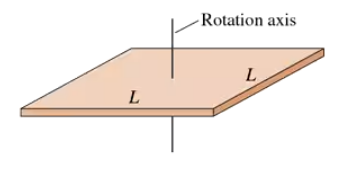
Determine the moment of inertia about the axis of the object shown in FIGURE P12.52.
A 3.0-m-long ladder, as shown in Figure 12.35, leans against a frictionless wall. The coefficient of static friction between the ladder and the floor is 0.40. What is the minimum angle the ladder can make with the floor without slipping?