Ch 12: Rotation of a Rigid Body
Knight Calc - Physics for Scientists and Engineers 5th Edition
Knight Calc5th EditionPhysics for Scientists and EngineersISBN: 9780137344796Not the one you use?Change textbook
Chapter 12, Problem 49b

A small 300 g ball and a small 600 g ball are connected by a 40-cm-long, 200 g rigid rod. b. What is the rotational kinetic energy if the structure rotates about its center of mass at 100 rpm?

Verified step by step guidance
1
Determine the total mass of the system by adding the masses of the two balls and the rod. Convert all masses to kilograms for consistency.
Find the center of mass of the system. Use the formula for the center of mass: xcm = (Σmixi)/(Σmi), where mi is the mass of each component and xi is its position relative to a reference point. Assume the rod is uniform and its mass is distributed evenly.
Calculate the moment of inertia of the system about the center of mass. Use the formula for the moment of inertia: I = Σmiri2, where ri is the distance of each mass from the center of mass.
Convert the rotational speed from revolutions per minute (rpm) to radians per second using the conversion factor: 1 \, \(\text{rpm}\) = \(\frac{2π}{60}\) \, \(\text{rad/s}\).
Calculate the rotational kinetic energy using the formula: KErot = \(\frac{1}{2}\)Iω2, where I is the moment of inertia and ω is the angular velocity in radians per second.

Verified video answer for a similar problem:

This video solution was recommended by our tutors as helpful for the problem above.
Video duration:
14m
Was this helpful?

Key Concepts

Here are the essential concepts you must grasp in order to answer the question correctly.

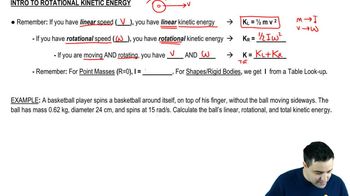
Rotational Kinetic Energy

Rotational kinetic energy is the energy possessed by an object due to its rotation. It is calculated using the formula KE_rot = 1/2 I ω², where I is the moment of inertia and ω is the angular velocity in radians per second. This concept is crucial for understanding how the mass distribution and rotation speed of an object contribute to its overall energy.
Recommended video:
Guided course
06:07
Intro to Rotational Kinetic Energy

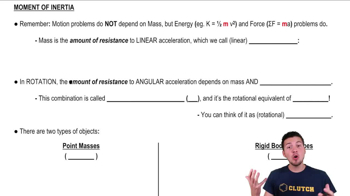
Moment of Inertia

The moment of inertia is a measure of an object's resistance to changes in its rotational motion. It depends on the mass of the object and the distribution of that mass relative to the axis of rotation. For composite systems, like the one in the question, the total moment of inertia is the sum of the individual moments of inertia of each component, calculated based on their distances from the axis of rotation.
Recommended video:
Guided course
11:47
Intro to Moment of Inertia

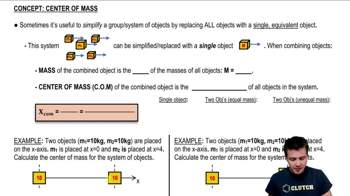
Center of Mass

The center of mass is the point at which the mass of a system is balanced and can be considered to act. For a system of particles or rigid bodies, the center of mass can be found by taking the weighted average of their positions based on their masses. Understanding the center of mass is essential for calculating the moment of inertia and analyzing the rotational dynamics of the system.
Recommended video:
Guided course
06:30
Intro to Center of Mass