Ch 26: Potential and Field
Knight Calc - Physics for Scientists and Engineers 5th Edition
Knight Calc5th EditionPhysics for Scientists and EngineersISBN: 9780137344796Not the one you use?Change textbook
Chapter 26, Problem 22

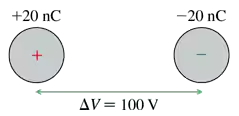
What is the capacitance of the two metal spheres shown in FIGURE EX26.22?
Two metal spheres with charges of +20 nC and -20 nC, separated by a distance with a potential difference of 100 V.

Verified step by step guidance
1
Step 1: Understand the concept of capacitance. Capacitance (C) is defined as the ratio of the charge (Q) on one conductor to the potential difference (ΔV) between the two conductors. The formula is: C=QΔV.
Step 2: Identify the given values from the figure. The charge on one sphere is 20×109 C (20 nC), and the potential difference between the spheres is 100 V.
Step 3: Substitute the values into the capacitance formula. Using C=QΔV, replace Q with 20×109 C and ΔV with 100 V.
Step 4: Perform the division to calculate the capacitance. Divide the charge by the potential difference: 20×109/100. This will give the capacitance in Farads (F).
Step 5: Interpret the result. The capacitance value obtained will be in Farads, which is the SI unit for capacitance. This value represents the ability of the two spheres to store charge per unit potential difference.

Verified video answer for a similar problem:

This video solution was recommended by our tutors as helpful for the problem above.
Was this helpful?

Key Concepts

Here are the essential concepts you must grasp in order to answer the question correctly.

Capacitance

Capacitance is the ability of a system to store electric charge per unit voltage. It is defined as the ratio of the charge (Q) stored on the conductors to the potential difference (V) between them, expressed as C = Q/V. In the case of two metal spheres, the capacitance can be calculated based on their charges and the potential difference between them.
Recommended video:
Guided course
08:02
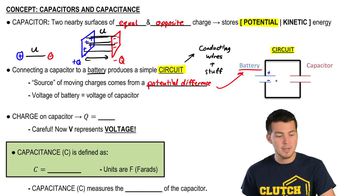
Capacitors & Capacitance (Intro)

Electric Potential Difference

Electric potential difference, or voltage (ΔV), is the work done per unit charge in moving a charge between two points in an electric field. It is a measure of the energy difference that drives the flow of electric charge. In this scenario, the potential difference of 100 V indicates the energy required to move a charge between the two spheres with opposite charges.
Recommended video:
Guided course
07:33
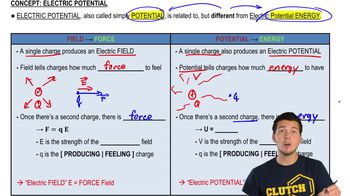
Electric Potential

Charge Distribution

Charge distribution refers to how electric charge is spread over a conductor's surface. In the case of the two spheres, one has a positive charge of +20 nC and the other a negative charge of -20 nC. This distribution affects the electric field between the spheres and is crucial for calculating the capacitance, as it determines how much charge can be stored for a given potential difference.
Recommended video:
Guided course
04:03
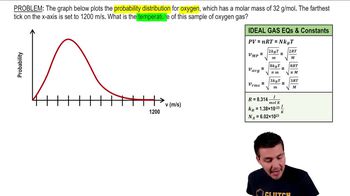
Probability Distribution Graph