Ch 26: Potential and Field
Knight Calc - Physics for Scientists and Engineers 5th Edition
Knight Calc5th EditionPhysics for Scientists and EngineersISBN: 9780137344796Not the one you use?Change textbook
Chapter 26, Problem 21a

Two 3.0-cm-diameter aluminum electrodes are spaced 0.50 mm apart. The electrodes are connected to a 100 V battery. What is the capacitance?

Verified step by step guidance
1
Step 1: Understand the formula for capacitance of a parallel plate capacitor. The capacitance is given by the formula: C=(εA)/d, where ε is the permittivity of the material between the plates, A is the area of the plates, and d is the separation between the plates.
Step 2: Identify the values given in the problem. The diameter of the electrodes is 3.0 cm, so the radius is 1.5 cm or 0.015 m. The separation between the plates is 0.50 mm or 0.0005 m. The material between the plates is air, so the permittivity is approximately ε=8.85×10¹²F/m.
Step 3: Calculate the area of the circular plates. The area of a circle is given by A=πr². Substitute the radius r=0.015m into the formula to find the area.
Step 4: Substitute the values for ε, A, and d into the capacitance formula. Use ε=8.85×10¹², the calculated area, and d=0.0005m.
Step 5: Simplify the expression to find the capacitance. Ensure the units are consistent throughout the calculation, and express the final capacitance in Farads (F).

Verified video answer for a similar problem:

This video solution was recommended by our tutors as helpful for the problem above.
Video duration:
6m
Was this helpful?

Key Concepts

Here are the essential concepts you must grasp in order to answer the question correctly.

Capacitance

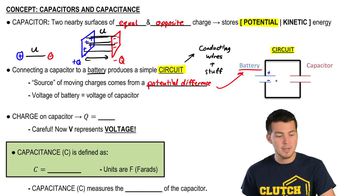
Capacitance is the ability of a system to store electric charge per unit voltage. It is defined as the ratio of the electric charge (Q) stored on the electrodes to the potential difference (V) across them, expressed as C = Q/V. The unit of capacitance is the farad (F), and it is influenced by the physical characteristics of the capacitor, including the area of the electrodes and the distance between them.
Recommended video:
Guided course
08:02
Capacitors & Capacitance (Intro)

Parallel Plate Capacitor

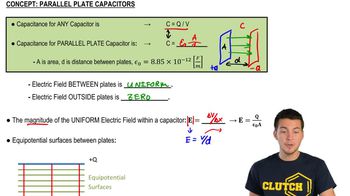
A parallel plate capacitor consists of two conductive plates separated by an insulating material (dielectric). The capacitance of such a capacitor can be calculated using the formula C = ε₀(A/d), where ε₀ is the permittivity of free space, A is the area of one of the plates, and d is the separation between the plates. This model simplifies the analysis of capacitors and is fundamental in understanding how they operate.
Recommended video:
Guided course
08:53
Parallel Plate Capacitors

Electric Field

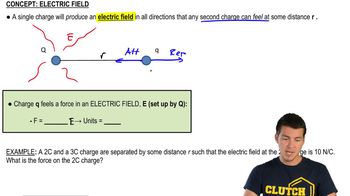
The electric field (E) is a vector field that represents the force per unit charge experienced by a positive test charge placed in the field. In the context of capacitors, the electric field between the plates is uniform and can be calculated using E = V/d, where V is the voltage across the plates and d is the separation distance. Understanding the electric field is crucial for analyzing how capacitors store energy and influence charge distribution.
Recommended video:
Guided course
03:16
Intro to Electric Fields