What is the capacitance of the two metal spheres shown in FIGURE EX26.22?
Ch 26: Potential and Field
Knight Calc5th EditionPhysics for Scientists and EngineersISBN: 9780137344796Not the one you use?Change textbook
Chapter 26, Problem 21b
Two 3.0-cm-diameter aluminum electrodes are spaced 0.50 mm apart. The electrodes are connected to a 100 V battery. What is the magnitude of the charge on each electrode?
Verified step by step guidance1
Step 1: Recognize that this is a problem involving a parallel-plate capacitor. The charge on each electrode can be determined using the formula for capacitance and the relationship between charge, capacitance, and voltage: \( Q = C \cdot V \).
Step 2: Calculate the capacitance \( C \) of the parallel-plate capacitor using the formula \( C = \frac{\varepsilon_0 \cdot A}{d} \), where \( \varepsilon_0 \) is the permittivity of free space \( (8.85 \times 10^{-12} \ \text{F/m}) \), \( A \) is the area of one electrode, and \( d \) is the separation between the plates.
Step 3: Compute the area \( A \) of one electrode using the formula for the area of a circle: \( A = \pi \cdot r^2 \), where \( r \) is the radius of the electrode. The diameter is given as 3.0 cm, so \( r = 1.5 \ \text{cm} = 0.015 \ \text{m} \).
Step 4: Substitute the values for \( \varepsilon_0 \), \( A \), and \( d \) into the capacitance formula \( C = \frac{\varepsilon_0 \cdot A}{d} \) to calculate the capacitance.
Step 5: Use the calculated capacitance \( C \) and the given voltage \( V = 100 \ \text{V} \) in the formula \( Q = C \cdot V \) to find the magnitude of the charge \( Q \) on each electrode.

Verified video answer for a similar problem:
This video solution was recommended by our tutors as helpful for the problem above.
Video duration:
8mWas this helpful?
Key Concepts
Here are the essential concepts you must grasp in order to answer the question correctly.
Capacitance
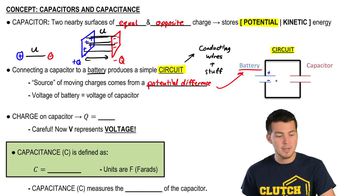
Capacitance is the ability of a system to store electric charge per unit voltage. It is defined as C = Q/V, where C is capacitance, Q is the charge stored, and V is the voltage across the electrodes. In this scenario, the capacitance can be calculated using the geometry of the electrodes and the distance between them.
Recommended video:
Guided course
Capacitors & Capacitance (Intro)
Electric Field
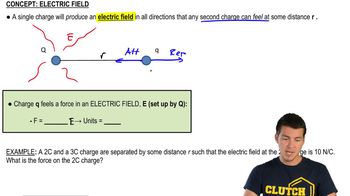
The electric field is a vector field that represents the force exerted by an electric charge on other charges in its vicinity. It is defined as E = V/d, where E is the electric field strength, V is the voltage, and d is the distance between the charges. Understanding the electric field is crucial for determining how charges interact in the given setup.
Recommended video:
Guided course
Intro to Electric Fields
Charge Distribution
Charge distribution refers to how electric charge is spread over a surface or within a volume. In the case of the electrodes, the charge will distribute evenly across their surfaces due to their symmetry. The total charge on each electrode can be calculated once the capacitance is known, using the relationship Q = C * V.
Recommended video:
Guided course
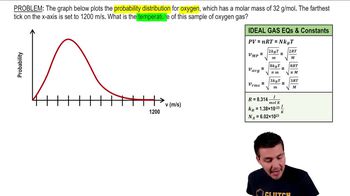
Probability Distribution Graph
Related Practice
Textbook Question
3
views
Textbook Question
Two 3.0-cm-diameter aluminum electrodes are spaced 0.50 mm apart. The electrodes are connected to a 100 V battery. What is the capacitance?
2
views
Textbook Question
Light from the sun allows a solar cell to move electrons from the positive to the negative terminal, doing 2.4×10⁻¹⁹ J of work per electron. What is the emf of this solar cell?
1
views
Textbook Question
A 6 μF capacitor, a 10 μF capacitor, and a 16 μF capacitor are connected in series. What is their equivalent capacitance?
1
views
Textbook Question
A switch that connects a battery to a 10 μF capacitor is closed. Several seconds later you find that the capacitor plates are charged to ±30 μC. What is the emf of the battery?
2
views
Textbook Question
How much charge does a 9.0 V battery transfer from the negative to the positive terminal while doing 27 J of work?
1
views