Ch 26: Potential and Field
Knight Calc - Physics for Scientists and Engineers 5th Edition
Knight Calc5th EditionPhysics for Scientists and EngineersISBN: 9780137344796Not the one you use?Change textbook
Chapter 26, Problem 25

A 6 μF capacitor, a 10 μF capacitor, and a 16 μF capacitor are connected in series. What is their equivalent capacitance?

Verified step by step guidance
1
When capacitors are connected in series, the reciprocal of the equivalent capacitance is the sum of the reciprocals of the individual capacitances. The formula is: 1Ceq=1C1+1C2+1C3.
Substitute the given capacitances into the formula: 1Ceq=16+110+116, where the capacitances are in microfarads (μF).
Find the least common denominator (LCD) of the fractions to simplify the addition. The LCD for 6, 10, and 16 is 240. Rewrite each fraction with this denominator: 40240+24240+15240.
Add the numerators of the fractions: 40240+24240+15240=79240. This gives the reciprocal of the equivalent capacitance.
Finally, take the reciprocal of the result to find the equivalent capacitance: Ceq=24079. Simplify the fraction if necessary, and the result will be in microfarads (μF).

Verified video answer for a similar problem:

This video solution was recommended by our tutors as helpful for the problem above.
Was this helpful?

Key Concepts

Here are the essential concepts you must grasp in order to answer the question correctly.

Capacitance

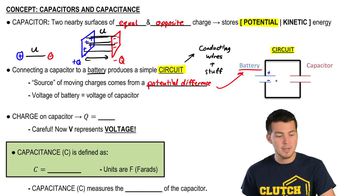
Capacitance is the ability of a capacitor to store electrical charge per unit voltage. It is measured in farads (F) and is defined as the ratio of the electric charge (Q) stored on one plate of the capacitor to the voltage (V) across the plates. In practical terms, a higher capacitance means a capacitor can store more charge at a given voltage.
Recommended video:
Guided course
08:02
Capacitors & Capacitance (Intro)

Capacitors in Series

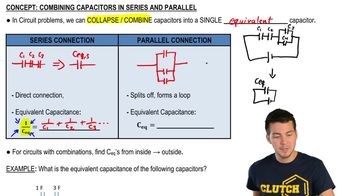
When capacitors are connected in series, the total or equivalent capacitance (C_eq) is less than the smallest individual capacitor in the series. The formula for calculating the equivalent capacitance of capacitors in series is given by 1/C_eq = 1/C1 + 1/C2 + 1/C3, where C1, C2, and C3 are the capacitances of the individual capacitors. This configuration results in a reduced ability to store charge compared to individual capacitors.
Recommended video:
Guided course
09:51
Combining Capacitors in Series & Parallel

Equivalent Capacitance

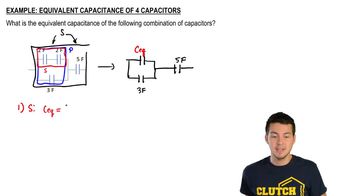
Equivalent capacitance is a single capacitance value that represents the combined effect of multiple capacitors in a circuit. It simplifies circuit analysis by allowing us to treat a group of capacitors as one capacitor. For series connections, the equivalent capacitance is calculated using the reciprocal formula, while for parallel connections, it is the sum of the individual capacitances.
Recommended video:
Guided course
03:44
Find Equivalent Capacitance #1