
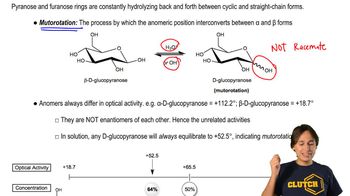
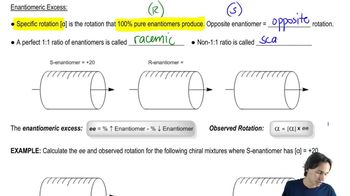
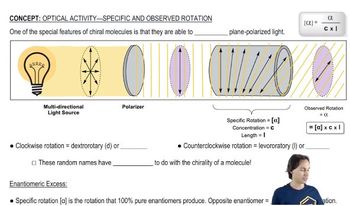
When optically pure (R)-2-bromobutane is heated with water, butan-2-ol is the product. The reaction forms twice as much (S)-butan-2-ol as (R)-butan-2-ol. Calculate the e.e. and the specific rotation expected for the product.
Verified step by step guidance
Verified video answer for a similar problem:
Key Concepts
Optical Activity and Enantiomers
Enantiomeric Excess (e.e.)
Specific Rotation
A chiral sample gives a rotation that is close to 180°. How can one tell whether this rotation is +180° or -180°?
A chemist finds that the addition of (+)-epinephrine to the catalytic reduction of butan-2-one (Figure 5-17 ) gives a product that is slightly optically active, with a specific rotation of +0.45°. Calculate the percentages of (+)-butan-2-ol and (−)-butan-2-ol formed in this reaction.
If you had the two enantiomers of carvone in unmarked bottles, could you use just your nose and a polarimeter to determine
a. whether it is the (+) or (−) enantiomer that smells like spearmint
b. whether it is the (R) or (S) enantiomer that smells like spearmint?
c. With the information given in the drawings of carvone above, what can you add to your answers to (a) and (b)?
A solution of 0.50 g of (−)-epinephrine (see Figure 5-16) dissolved in 10.0 mL of dilute aqueous HCl was placed in a 20-cm polarimeter tube. Using the sodium D line, the rotation was found to be −5.1° at 25 °C. Determine the specific rotation of epinephrine.
<IMAGE>
Make a model of each compound, draw it in its most symmetric conformation, and determine whether it is capable of showing optical activity.
a. 1-bromo-1-chloroethane
b. 1-bromo-2-chloroethane
