
Ch.5 - Stereochemistry
Wade - Organic Chemistry 9th Edition
Wade9th EditionOrganic ChemistryISBN: 9780135213728Not the one you use?Change textbook
Chapter 5, Problem 13

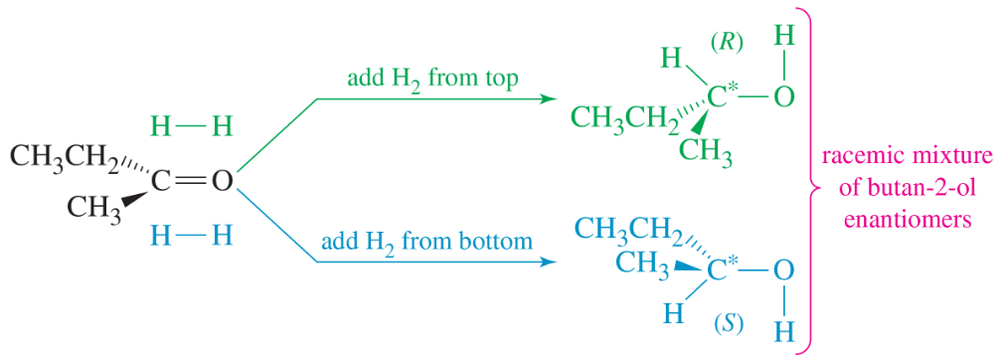
A chemist finds that the addition of (+)-epinephrine to the catalytic reduction of butan-2-one (Figure 5-17 ) gives a product that is slightly optically active, with a specific rotation of +0.45°. Calculate the percentages of (+)-butan-2-ol and (−)-butan-2-ol formed in this reaction.

Verified step by step guidance
1
Understand the problem: The reaction involves the catalytic reduction of butan-2-one to butan-2-ol in the presence of (+)-epinephrine, which results in a product that is optically active. This indicates that the reaction produces an unequal mixture of the enantiomers (+)-butan-2-ol and (−)-butan-2-ol. The specific rotation of the product is given as +0.45°.
Recall the formula for specific rotation: The specific rotation of a mixture of enantiomers is given by the equation: [α]mixture = (f+ × [α]+) + (f- × [α]-) , where f+ and f- are the fractions of the (+) and (−) enantiomers, respectively, and [α]+ and [α]- are their specific rotations. Note that [α]- = -[α]+ for enantiomers.
Set up the equation: The specific rotation of pure (+)-butan-2-ol is a known value (look up this value in a reference, typically around +13.5°). Let f+ represent the fraction of (+)-butan-2-ol and f- represent the fraction of (−)-butan-2-ol. Since the mixture is optically active with a specific rotation of +0.45°, substitute the known values into the equation: 0.45 = (f+ × 13.5) + (f- × -13.5).
Use the relationship between fractions: The total fraction of the two enantiomers must equal 1, so f+ + f- = 1. Solve for f- in terms of f+: f- = 1 - f+. Substitute this into the specific rotation equation.
Solve for the fractions: Substitute f- = 1 - f+ into the equation 0.45 = (f+ × 13.5) + ((1 - f+) × -13.5). Simplify and solve for f+. Once f+ is determined, calculate f- using f- = 1 - f+. Convert these fractions to percentages by multiplying by 100.

Verified video answer for a similar problem:

This video solution was recommended by our tutors as helpful for the problem above.
Video duration:
5m
Was this helpful?

Key Concepts

Here are the essential concepts you must grasp in order to answer the question correctly.

Optical Activity

Optical activity refers to the ability of chiral compounds to rotate plane-polarized light. This property is crucial in organic chemistry for distinguishing between enantiomers, which are non-superimposable mirror images of each other. The specific rotation, measured in degrees, quantifies this rotation and helps determine the composition of a mixture of enantiomers.
Recommended video:
Guided course
08:17
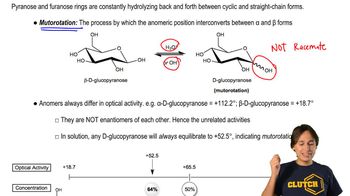
Mutorotation and Optical Activity

Chirality and Enantiomers

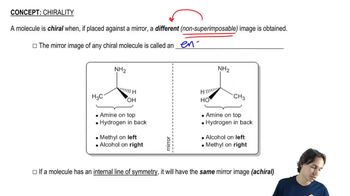
Chirality is a property of a molecule that makes it non-superimposable on its mirror image, often due to the presence of a chiral center, typically a carbon atom bonded to four different groups. Enantiomers are pairs of chiral molecules that are mirror images of each other, and they can exhibit different biological activities and properties, making their separation and quantification important in synthesis and analysis.
Recommended video:
Guided course
05:10
What is chirality?

Catalytic Reduction

Catalytic reduction is a chemical reaction that involves the addition of hydrogen to a compound, often facilitated by a catalyst, to reduce functional groups such as ketones to alcohols. In the context of butan-2-one, the reaction produces butan-2-ol, and the presence of a chiral catalyst like (+)-epinephrine can influence the stereochemical outcome, leading to the formation of enantiomers in varying proportions.
Recommended video:
3:21
Catalytic Allylic Alkylation Concept 1
Related Practice
Textbook Question
One of the crowning achievements of natural products synthesis was Bryostatin 1, published by Professor Gary Keck (University of Utah; Journal of the American Chemical Society, 2011, 133, 744–747). The Bryostatins are a familyof compounds isolated from aquatic invertebrates known as Bryozoans. The compounds are of interest for a variety of biological effects, including anti-cancer activity and reversing brain damage in rodents.(d) How many chiral centers are in this molecule?(e) Using the number of chiral centers you reported in part(d), calculate the number of stereoisomers possible atthese chiral centers. (Ignore stereoisomers at double bonds.)
2
views
Textbook Question

A chiral sample gives a rotation that is close to 180°. How can one tell whether this rotation is +180° or -180°?

2
views
Textbook Question

When optically pure (R)-2-bromobutane is heated with water, butan-2-ol is the product. The reaction forms twice as much (S)-butan-2-ol as (R)-butan-2-ol. Calculate the e.e. and the specific rotation expected for the product.

2
views
Textbook Question

If you had the two enantiomers of carvone in unmarked bottles, could you use just your nose and a polarimeter to determine

a. whether it is the (+) or (−) enantiomer that smells like spearmint

b. whether it is the (R) or (S) enantiomer that smells like spearmint?

c. With the information given in the drawings of carvone above, what can you add to your answers to (a) and (b)?

1
views
Textbook Question

Make a model of each compound, draw it in its most symmetric conformation, and determine whether it is capable of showing optical activity.

a. 1-bromo-1-chloroethane

b. 1-bromo-2-chloroethane

1
views
Textbook Question

Draw three-dimensional representations of the following compounds. Which have asymmetric carbon atoms? Which have no asymmetric carbons but are chiral anyway? Use your models for parts (a) through (d) and any others that seem unclear.

(a)

(b)

3
views