
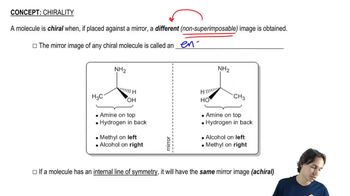
Make a model of each compound, draw it in its most symmetric conformation, and determine whether it is capable of showing optical activity.
a. 1-bromo-1-chloroethane
b. 1-bromo-2-chloroethane
Verified step by step guidance
Verified video answer for a similar problem:
Key Concepts
Stereoisomerism
Chirality
Optical Activity
Draw three-dimensional representations of the following compounds. Which have asymmetric carbon atoms? Which have no asymmetric carbons but are chiral anyway? Use your models for parts (a) through (d) and any others that seem unclear.
(c)
(d)
A chemist finds that the addition of (+)-epinephrine to the catalytic reduction of butan-2-one (Figure 5-17 ) gives a product that is slightly optically active, with a specific rotation of +0.45°. Calculate the percentages of (+)-butan-2-ol and (−)-butan-2-ol formed in this reaction.
When optically pure (R)-2-bromobutane is heated with water, butan-2-ol is the product. The reaction forms twice as much (S)-butan-2-ol as (R)-butan-2-ol. Calculate the e.e. and the specific rotation expected for the product.
Draw three-dimensional representations of the following compounds. Which have asymmetric carbon atoms? Which have no asymmetric carbons but are chiral anyway? Use your models for parts (a) through (d) and any others that seem unclear.
(e)
(f)
Draw three-dimensional representations of the following compounds. Which have asymmetric carbon atoms? Which have no asymmetric carbons but are chiral anyway? Use your models for parts (a) through (d) and any others that seem unclear.
(a)
(b)
