
Textbook Question
Write structural formulas for the following compounds
(includes both old- and new-style names).
(j) vinylacetylene
(k) (S)-3-methyl-1-penten-4-yne
6
views

 Verified step by step guidance
 05:43
05:43
 08:17
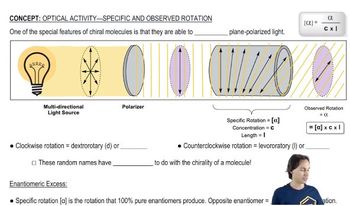
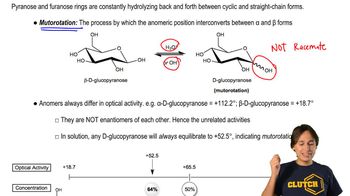
08:17A chiral sample gives a rotation that is close to 180°. How can one tell whether this rotation is +180° or -180°?
In Problem 5-3, you drew the enantiomers for a number of chiral compounds. Now go back and designate each asymmetric carbon atom as either (R) or (S).
(e) chlorocyclohexane
(f) cis-1,2-dichlorocyclobutane
When optically pure (R)-2-bromobutane is heated with water, butan-2-ol is the product. The reaction forms twice as much (S)-butan-2-ol as (R)-butan-2-ol. Calculate the e.e. and the specific rotation expected for the product.
A solution of 2.0 g of (+)-glyceraldehyde, HOCH2CHOHCHO, in 10.0 mL of water was placed in a 100-mm cell. Using the sodium D line, a rotation of +1.74° was found at 25 °C. Determine the specific rotation of (+)-glyceraldehyde
If you had the two enantiomers of carvone in unmarked bottles, could you use just your nose and a polarimeter to determine
a. whether it is the (+) or (−) enantiomer that smells like spearmint
b. whether it is the (R) or (S) enantiomer that smells like spearmint?
c. With the information given in the drawings of carvone above, what can you add to your answers to (a) and (b)?